The phrase “online GLP-1 program” appears everywhere in telehealth marketing, but its meaning is rarely defined. This overview sets context for how the term is used, what it actually represents, and why role clarity matters before examining the definition itself.
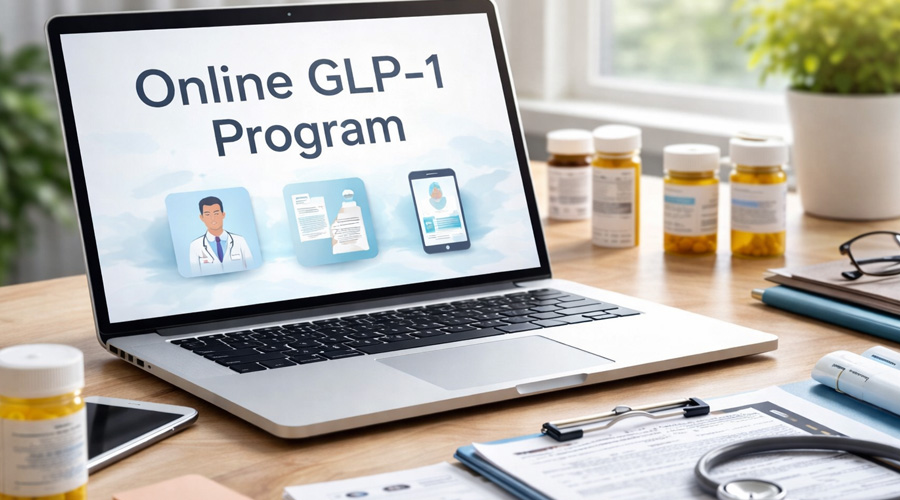
An online GLP-1 program is a telehealth-based service that combines a digital platform with access to licensed clinicians and pharmacy fulfillment for GLP-1 medications. The term is used broadly to describe the overall service experience, not a single medical action or prescription.
In practice, “online GLP-1 program” is a consumer-facing label. It usually refers to a structured service that organizes intake tools, clinician access, and medication coordination through one website or app. The program itself does not practice medicine or make treatment decisions.
The phrase is commonly used by telehealth companies to simplify complex roles. It groups together platform software, administrative services, and clinician networks under one name, even though those functions remain legally and operationally separate.
1. How the Term “Online GLP-1 Program” Is Commonly Used by Telehealth Companies
The phrase “online GLP-1 program” is most often used as a shorthand description in consumer-facing language. It is commonly seen across public-facing materials as a way to name the entire service being offered.
Common placements include:
Website headers and landing pages
Advertisements and promotional copy
Frequently asked questions sections
Search result titles and snippets
In this context, the term does not point to a defined clinical model. It functions as an umbrella label that groups several connected services together under one name for clarity and simplicity.
Telehealth companies use this phrasing to reduce friction during early research. Rather than listing each separate role involved, the program label signals that multiple functions are coordinated through a single online entry point (NIH, 2023).
Important Clarification
This usage prioritizes accessibility over precision. While convenient for communication, it can obscure the distinction between technology platforms, licensed clinicians, and external pharmacies unless those roles are explained separately.
2. What the Word “Program” Means in an Online GLP-1 Program
Within online GLP-1 services, the word “program” is used as an organizing term rather than a technical one. It signals that the service is structured, ongoing, and coordinated through a central system.
The program label usually covers non-clinical elements. Common examples include:
The digital interface used to access the service
Account management and administrative support
Communication tools that connect separate parties
Importantly, the program itself is not a medical provider. It does not perform clinical functions such as:
Diagnosing medical conditions
Determining eligibility for treatment
Prescribing medication
Those decisions remain the responsibility of licensed clinicians who operate within or alongside the program framework (Cleveland Clinic, 2024).
Important Clarification
Marketing language may make an online GLP-1 program appear more authoritative than it is. The program label does not change the separation between platforms, licensed clinicians, and other entities involved in care.
3. Online GLP-1 Program vs Platform vs Provider Explained
In online GLP-1 services, the terms program, platform, and provider describe different functions. These words are often used interchangeably, but they refer to distinct roles within the overall service.
Table 1. Program, Platform, and Provider Role Distinctions
Term
What it refers to
Primary role
Medical authority
What it does not do
Program
The overall service structure
Coordinates access and service experience
None
Does not diagnose, prescribe, or make clinical decisions
Platform
The technology layer
Manages accounts, data collection, and communication tools
None
Does not provide medical care or pharmacy services
Provider
Licensed clinicians or clinical groups
Makes medical judgments and prescribing decisions
Yes
Does not operate or control the technology platform
A platform is the technology layer. It includes the website or app, user accounts, data collection tools, and communication systems that support the service experience.
A provider refers to a licensed clinician or clinical group. Providers are responsible for medical judgment, including evaluations, eligibility decisions, and prescribing when appropriate (Mayo Clinic, 2024).
Important Clarification
The program sits above these roles as a coordinating structure. It connects platforms and provider networks under one branded service, without replacing or absorbing their separate responsibilities.
4. Why Telehealth Companies Use the Term “Online GLP-1 Program”
Telehealth companies commonly use the word “program” because it is familiar and broadly understood. The term signals organization and continuity without requiring consumers to parse regulatory or clinical distinctions.
Common reasons this wording is used include:
It provides a single label for multiple coordinated services
It avoids technical or regulatory language in public explanations
It supports consistent branding across different states or offerings
From a communication standpoint, “program” functions as neutral framing. It allows companies to describe an ongoing service relationship without claiming medical authority or clinical ownership.
This preference reflects language strategy rather than structure. The choice of wording simplifies explanation, but it does not change who provides care or who holds medical responsibility.
5. What Is Included in an Online GLP-1 Program
At a high level, an online GLP-1 program refers to a bundled service experience rather than a single feature. The exact components vary by company, but the term usually signals coordination across several non-clinical and clinical touchpoints.
Common elements often described as part of a program include:
Table 2. Common Components Included in an Online GLP-1 Program
Program component
What it generally covers
Who typically provides it
Digital platform
Account access, forms, and messaging tools
Technology company
Clinician access
Medical review and decision-making
Licensed clinicians
Pharmacy coordination
Medication routing and fulfillment logistics
External pharmacies
Program management
Administrative support and service updates
Program operator
These components are presented collectively for simplicity. Their inclusion under one label does not mean they are owned or controlled by the same entity (NIH, 2023).
6. What an Online GLP-1 Program Does Not Control or Decide
An online GLP-1 program does not hold medical authority. The program itself does not make clinical judgments or treatment decisions.
Key areas that remain outside program control include:
Table 3. Areas Not Controlled by an Online GLP-1 Program
Area
Who controls it
Why the program does not
Medical evaluations
Licensed clinicians
Medical judgment is legally restricted to clinicians
Eligibility decisions
Licensed clinicians
Eligibility depends on individual clinical assessment
Prescribing decisions
Licensed clinicians
Prescribing authority cannot be delegated
Pharmacy dispensing
External pharmacies
Dispensing is regulated separately from platforms
These limits are structural rather than optional. They exist to separate technology and administration from regulated medical practice (NIH, 2023).
7. Common Misunderstandings About Online GLP-1 Programs
The phrase “online GLP-1 program” is often misunderstood as describing a single entity that manages all aspects of care. This assumption can arise when marketing language compresses multiple roles into one label.
Common points of misunderstanding include:
Assuming the program itself provides medical treatment
Believing clinical decisions are made by the platform or program
Confusing coordination with direct control over medication
In practice, the program coordinates access, while licensed clinicians independently handle medical decisions. Programs may also facilitate pharmacy connections, but they do not manufacture, approve, or dispense medications directly (FDA, via NIH, 2023).
Important Clarification
These misunderstandings stem from terminology, not intent. Clarifying how the term is used helps align expectations with how online GLP-1 services are actually structured.
8. Why Precise Definitions Matter When Researching Online GLP-1 Programs
Terminology plays an outsized role during early and mid-stage GLP-1 research. Because online services bundle multiple roles, imprecise language can create false assumptions about authority and responsibility.
Common effects of unclear terminology include:
Assuming a single provider controls the entire service
Misunderstanding where medical authority resides
Confusing coordination with clinical responsibility
Using the term “online GLP-1 program” without clarification may suggest a single provider model. In practice, the structure is modular, with separate entities handling technology, clinical care, and pharmacy services.
Clear terminology supports accurate comparisons. When roles are understood correctly, differences between services can be evaluated based on structure rather than branding language.
For research-focused readers, precision reduces rework. It limits the need to reinterpret claims later when legal disclosures or clinical boundaries become more visible.
9. How to Interpret the Phrase “Online GLP-1 Program” Accurately
In practice, the phrase “online GLP-1 program” is a simplified label for a coordinated service model. It is not a medical entity, treatment plan, or guarantee of care.
The term groups together technology platforms, administrative services, and access to licensed clinicians under one name. Each of these elements retains separate roles, authority, and responsibility.
Understanding this distinction helps frame research more accurately. It allows the term to be read as a description of structure and access, rather than a definition of who provides medical care or makes clinical decisions (NIH, 2023).
Sources:
National Institutes of Health (NIH). Telehealth and digital health services overview. 2023.
Cleveland Clinic. Telehealth care models and clinician responsibility. 2024.
Mayo Clinic. Medical decision-making and prescribing authority. 2024.
U.S. Food and Drug Administration (FDA). Regulation of prescription drugs and pharmacy dispensing. 2023.
National Institutes of Health (NIH). FDA oversight and medication approval processes. 2023.