GLP-1 telehealth programs and weight-loss clinics frequently appear similar on the surface. Behind the scenes, they operate under different structures, responsibilities, and regulatory boundaries. Understanding these differences helps explain how care is organized, who makes medical decisions, and what each model controls.
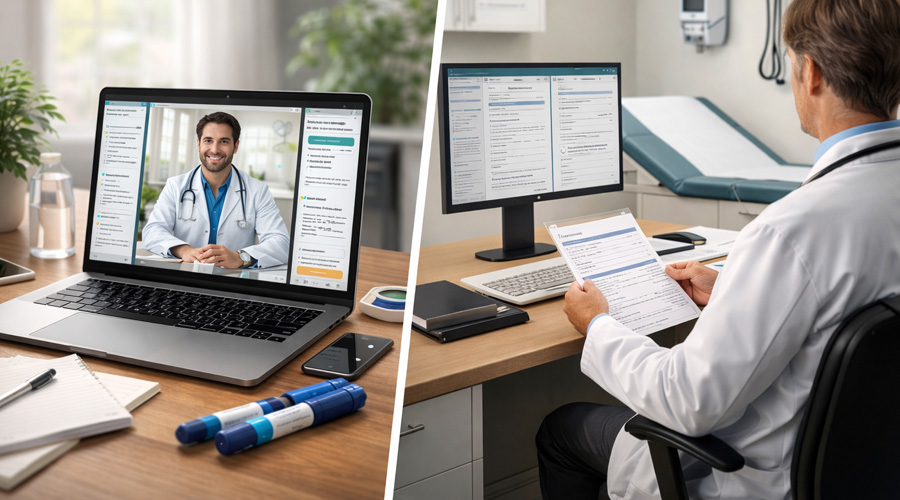
GLP-1 telehealth programs differ from weight-loss clinics mainly in how care is organized, delivered, and administered. Telehealth programs operate through online platforms that coordinate medical intake, clinician review, and pharmacy fulfillment remotely, while weight-loss clinics function as physical practices where these activities occur within one in-person setting.
These differences reflect distinct care delivery models. Online GLP-1 telehealth programs separate platform operations from clinical decision-making through remote licensed clinicians. Weight-loss clinics typically integrate administrative staff, clinicians, and medical records within a single practice.
As a result, GLP-1 telehealth program structure centers on digital workflows and centralized systems. Clinic-based models center on on-site care, direct staff coordination, and localized oversight.
1. GLP-1 Telehealth Program Structure vs Weight-Loss Clinic Structure
GLP-1 telehealth programs and weight-loss clinics are built around different organizational designs.
Telehealth programs are typically structured as technology platforms that coordinate services across multiple parties.
Clinics are structured as medical practices that house these functions internally.
Table 1. Structural Differences Between GLP-1 Telehealth Programs and Weight-Loss Clinics
Clinicians employed by or contracted with the clinic
Medical records
Stored and accessed through the platform
Maintained within the clinic
Pharmacy coordination
Handled through external partner pharmacies
Often coordinated through local or affiliated pharmacies
Operational control
Distributed across platform, clinicians, and pharmacies
Concentrated within one practice
In telehealth programs, the platform manages digital intake, account access, and system workflows. Licensed clinicians provide medical review and prescribing decisions independently within that system. Pharmacy fulfillment is often handled by separate partner pharmacies rather than by the platform itself (NIH, 2023).
Weight-loss clinics usually operate as single legal practices. Administrative staff, clinicians, medical records, and medication coordination are managed within one organization. This structure places most operational and clinical activities under the clinic’s direct control.
2. Platform Role vs Clinician Role in GLP-1 Telehealth Programs and Clinics
A key difference between GLP-1 telehealth programs and weight-loss clinics is how responsibilities are divided.
Telehealth programs rely on a clear separation between the platform’s role and the clinician’s role.
Clinics typically combine these responsibilities within one practice.
Table 2. Platform and Clinician Roles in GLP-1 Telehealth Programs and Clinics
Responsibility area
GLP-1 telehealth platforms
Licensed clinicians
Weight-loss clinics
Medical intake review
Provides tools and access
Reviews and evaluates intake
Conducts and reviews intake
Prescribing decisions
Does not make decisions
Determines and issues prescriptions
Determines and issues prescriptions
Medical judgment
No clinical authority
Holds full clinical authority
Holds full clinical authority
Administrative systems
Manages digital accounts and tools
Uses systems for care delivery
Managed internally by clinic
Medical records
Hosts or facilitates record storage
Documents clinical findings
Maintains records in practice systems
Legal accountability
Limited to platform operations
Accountable under medical license
Accountable as medical practice
In telehealth programs, the platform manages non-clinical functions such as user accounts, digital forms, communication tools, and record storage. Licensed clinicians use the platform to review medical intake, make eligibility determinations, and issue prescriptions based on clinical judgment.
In clinic settings, clinicians and administrative staff usually work within the same organization. Medical evaluations, documentation, prescribing, and follow-up are handled under a unified operational structure rather than across separate entities (Cleveland Clinic, 2024).
Important Clarification. Platform access and account setup do not constitute clinical approval. Medical eligibility, prescribing decisions, and treatment authority remain solely with licensed clinicians, not the telehealth platform.
3. GLP-1 Care Delivery Models in Telehealth Programs vs Clinics
Care delivery in GLP-1 telehealth programs and weight-loss clinics follows different operational patterns. These patterns reflect how care interactions are structured rather than where care is delivered.
Table 3. GLP-1 Care Delivery Models in Telehealth Programs and Weight-Loss Clinics
Care delivery element
GLP-1 telehealth programs
Weight-loss clinics
Initial evaluation
Completed through digital intake and questionnaires
Conducted during in-person office visits
Clinician review
Performed remotely within the platform
Performed on-site by clinic clinicians
Documentation
Submitted and stored digitally
Collected and documented on-site
Follow-up interactions
Managed through secure messaging or virtual visits
Managed through repeat in-person appointments
4. Administrative Workflow and Patient Intake in GLP-1 Telehealth vs Clinics
Administrative processes differ significantly between GLP-1 telehealth programs and weight-loss clinics.
Telehealth programs are designed around standardized digital workflows.
Clinics rely on in-practice administrative systems that support in-person care delivery.
Table 4. Administrative Workflow and Patient Intake in GLP-1 Telehealth Programs and Clinics
Administrative stage
GLP-1 telehealth programs
Weight-loss clinics
Intake method
Online forms completed through platform
Forms completed during visits or clinic systems
Identity verification
Handled digitally within platform
Verified by clinic staff
Consent and disclosures
Accepted electronically before review
Collected during or before visits
Medical history collection
Submitted asynchronously before clinician review
Collected during in-person evaluation
Record storage
Maintained within platform systems
Maintained within clinic records
Administrative support
Centralized platform operations
On-site clinic staff
In telehealth programs, patient intake usually occurs through online forms completed before clinician review. Identity verification, consent acknowledgments, and record collection are handled within the platform. These steps are often completed before any clinical interaction occurs (Mayo Clinic, 2024).
Weight-loss clinics typically manage intake at the practice level. Forms, documentation, and medical history are collected during office visits or through clinic-managed systems. Administrative staff support these processes directly within the clinic environment.
Important Clarification. Completing digital intake forms or identity verification does not indicate clinical approval. Medical review, eligibility determinations, and prescribing decisions occur only after evaluation by a licensed clinician.
5. GLP-1 Telehealth Access Pathways and Clinic Scheduling Models
Access pathways are structured differently in GLP-1 telehealth programs and weight-loss clinics. These differences reflect how access is organized rather than how quickly care is obtained.
In GLP-1 telehealth programs, access pathways commonly include:
Account-based entry through an online platform
Scheduling managed within centralized digital systems
Messaging and updates delivered through platform tools
Clinician availability coordinated across a distributed network
In weight-loss clinics, access pathways commonly include:
Appointment booking through clinic scheduling systems
Visits tied to specific providers and physical locations
Communication routed through clinic staff outside of visits
6. GLP-1 Pharmacy Fulfillment and Medication Coordination Models
Pharmacy coordination follows different operational models across GLP-1 telehealth programs and weight-loss clinics.
Telehealth programs typically coordinate fulfillment through external pharmacy partners.
Clinics may manage medication coordination more directly within their practice workflows.
Table 5. Pharmacy Fulfillment and Medication Coordination in GLP-1 Telehealth Programs and Clinics
Fulfillment function
GLP-1 telehealth programs
Weight-loss clinics
Prescription issuance
Issued by licensed clinicians through the platform
Issued by clinic-based clinicians
Medication dispensing
Performed by external partner pharmacies
Coordinated through local or affiliated pharmacies
Platform involvement
Facilitates order transmission only
Not applicable
Pharmacy selection
Determined by program partnerships and regulation
Determined by clinic relationships and location
Shipping and delivery
Managed by dispensing pharmacy
Managed by pharmacy or clinic workflows
Regulatory responsibility
Held by licensed pharmacy
Held by licensed pharmacy
In telehealth programs, once a licensed clinician issues a prescription, the order is routed to a partner pharmacy for dispensing and shipping. The platform facilitates information transfer but does not usually dispense medication itself. Pharmacy fulfillment operates as a separate regulated function (NIH, 2023).
Weight-loss clinics may coordinate prescriptions through local or affiliated pharmacies. Medication discussions, prescription routing, and follow-up questions are often handled within the clinic’s existing clinical and administrative systems.
7. Regulatory Oversight of GLP-1 Telehealth Programs and Clinics
GLP-1 telehealth programs and weight-loss clinics operate under different regulatory and oversight structures. These differences reflect how each model is licensed, supervised, and monitored within the U.S. healthcare system.
Table 6. Regulatory Oversight of GLP-1 Telehealth Programs and Weight-Loss Clinics
Oversight area
GLP-1 telehealth programs
Weight-loss clinics
Governing rules
State-specific telemedicine regulations
State medical practice regulations
Clinician licensure
Required in each state where care is provided
Required in state where clinic operates
Platform responsibility
Maintains compliant digital systems
Not applicable
Clinical accountability
Held by licensed clinicians under professional licenses
Held by clinic-based clinicians
Practice supervision
Distributed across platform and clinicians
Managed at the clinic level
Important Clarification. Telehealth platforms provide the technical systems required to meet regulatory rules. They do not oversee clinicians, approve medical decisions, or act as medical regulators. Clinical oversight and accountability remain with licensed clinicians and state medical boards (NIH, 2023).
8. Operational Limits and Non-Guarantees in GLP-1 Care Models
Both GLP-1 telehealth programs and weight-loss clinics operate within defined limits. Neither model controls every aspect of care delivery, outcomes, or ongoing access. These limits are shaped by regulation, clinician judgment, and system design.
Table 7. Operational Limits and Non-Guarantees in GLP-1 Telehealth Programs and Weight-Loss Clinics
Limit area
GLP-1 telehealth programs
Weight-loss clinics
Prescription decisions
No guarantee that a prescription will be issued
Determined by clinic-based clinicians
Medication availability
No control over pharmacy stock or dispensing
Dependent on pharmacy and clinic coordination
Clinical authority
Medical decisions made independently by licensed clinicians
Medical decisions made by clinic-based clinicians
Fulfillment and shipping
Governed by pharmacy regulations
Governed by pharmacy and clinic workflows
Participation and continuity
No guarantee of continued access or participation
No guarantee of participation, continuity, or treatment decisions
9. Summary of Key Differences Between GLP-1 Telehealth Programs and Clinics
GLP-1 telehealth programs and weight-loss clinics represent two distinct care delivery models. Telehealth programs are built around digital platforms that coordinate remote clinical services across separate entities. Weight-loss clinics operate as physical medical practices with integrated staff, records, and workflows.
These structural differences shape how care is delivered, managed, and regulated. Neither model is inherently uniform, and individual programs or clinics may vary in execution. Licensed clinicians remain responsible for medical decisions in both settings, regardless of delivery model (Cleveland Clinic, 2024).
Sources:
National Institutes of Health (NIH). Telehealth and medical regulation overview, 2023.
Mayo Clinic. Telehealth services and clinical review processes, 2024.
Cleveland Clinic. Differences between clinical care settings and care delivery models, 2024.
U.S. Department of Health and Human Services (HHS). Telehealth policy and regulatory framework, 2024.
Centers for Medicare & Medicaid Services (CMS). Telemedicine and virtual care program guidance, 2024.