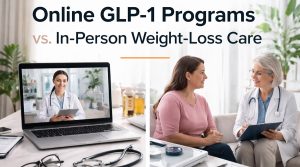
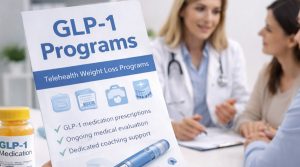
Online GLP-1 weight-loss programs are often described in simple terms, but their structure is more layered than it appears. Understanding how platforms, clinicians, and pharmacies interact explains why access, pricing, and eligibility can vary.
Online GLP-1 weight-loss programs connect a digital platform, a licensed clinician, and a pharmacy into one coordinated system. The platform manages intake and access, while clinicians make eligibility and prescribing decisions, and pharmacies handle medication preparation and delivery.
This structure separates administrative functions from medical judgment. Platforms support enrollment and communication, clinicians oversee medical review, and pharmacies control dispensing and shipping.
Because these roles are distinct, pricing, access, and requirements vary by program. Enrollment does not guarantee eligibility, prescribing, or ongoing access, which remain dependent on clinician review and pharmacy fulfillment.
1. What Online GLP-1 Weight-Loss Programs Are and How They Are Structured
Online GLP-1 weight-loss programs are not medical providers. They are technology-based platforms designed to organize access to licensed clinicians and pharmacy services through a single online system.
These platforms focus on administrative coordination rather than care delivery. Their role is to manage digital intake forms, scheduling tools, payment systems, and communication infrastructure. Medical evaluation and prescribing authority remain outside the platform.
In most cases, an online GLP-1 program brings together multiple parties, each with a defined role in the overall process.
Table 1. Core Roles in an Online GLP-1 Weight-Loss Program
Role
Primary responsibility
What it controls
What it does not control
Digital platform
Administrative coordination and technology access
Enrollment workflows, user accounts, intake forms, billing systems, communication tools
Medical evaluation, eligibility decisions, prescribing authority, medication dispensing
This separation is intentional. U.S. healthcare rules require that medical decisions be made by licensed professionals, not by software companies. As a result, online GLP-1 programs function as coordinators rather than treatment providers (Mayo Clinic, 2024).
2. The Typical Online GLP-1 Program Enrollment and Intake Process
Online GLP-1 weight-loss programs usually follow a structured enrollment sequence. This sequence is designed to collect required information, route it to a clinician, and document each step for compliance purposes (NIH, 2023).
Table 2. Typical Enrollment Stages in Online GLP-1 Weight-Loss Programs
Enrollment stage
What happens
Who controls it
Account setup
Basic profile and access credentials are created on the platform
Platform
Medical intake
Health history and disclosures are submitted through online forms
Platform collects information
Clinical review
Intake information is evaluated for eligibility and prescribing
Licensed clinician
Prescription routing
Approved prescriptions are sent to a pharmacy
Licensed clinician
Online Medical Intake
Enrollment typically begins with an online medical intake. This intake is completed through the platform and is required before any clinician review occurs.
Medical intake forms commonly collect
Basic personal and demographic information
Self-reported medical history and conditions
Current medications and relevant health disclosures
The platform’s role is limited to collecting and storing this information securely. The intake itself does not determine eligibility or lead directly to prescribing.
Licensed Clinician Review
After intake submission, a licensed clinician reviews the information. This review determines whether the individual meets clinical criteria for a prescription.
Clinician review may involve:
Asynchronous chart review based on submitted intake
Follow-up questions sent through secure platform messaging
A scheduled telehealth visit, depending on the program
Prescriptions are issued only if the clinician determines that treatment is appropriate. Enrollment alone does not guarantee approval, and decisions may differ across clinicians and programs.
3. GLP-1 Prescribing and Medication Decision Process
Prescribing decisions within online GLP-1 weight-loss programs are made solely by licensed clinicians. Platforms do not approve, deny, or influence whether a prescription is issued.
Clinicians evaluate intake information to determine whether prescribing is clinically appropriate. Decisions are based on medical history, disclosed conditions, and professional judgment, and conclusions may vary between clinicians.
When a prescription is issued, it may reference FDA-approved medication or compounded medication, depending on clinical judgment and pharmacy arrangements. Platforms may display general medication information but do not select, prescribe, or manage how medications are issued.
Prescribing authority remains separate from enrollment and payment systems. Participation in a program does not guarantee that medication will be prescribed, continued, or renewed (Cleveland Clinic, 2024).
Important Clarification. Platform membership, payment status, or prior prescriptions do not determine whether medication is prescribed. All prescribing decisions are made independently by licensed clinicians based on current clinical review.
4. GLP-1 Pharmacy Fulfillment and Medication Delivery
Once a prescription is issued, it is transmitted to a pharmacy associated with the program. The pharmacy operates independently from both the platform and the clinician.
Pharmacy fulfillment is responsible for preparing the medication, verifying the prescription, and arranging shipment. This process follows pharmacy regulations and internal quality controls, not platform policies.
Pharmacy fulfillment typically includes:
Reviewing the prescription for accuracy and completeness
Preparing FDA-approved or compounded medication as prescribed
Packaging and shipping medication to the address on file
Delivery timing, packaging methods, and refill handling vary by pharmacy. Platforms may display estimated timelines, but they do not control how medications are prepared, shipped, or delivered. Any delays, substitutions, or fulfillment limitations are handled at the pharmacy level (NIH, 2023).
5. How Online GLP-1 Program Pricing Is Structured
Pricing in online GLP-1 weight-loss programs is typically split into multiple components. Platforms usually present these costs during enrollment, but the structure can vary across providers.
Table 3. Common Pricing Components in Online GLP-1 Programs
Cost category
What it typically covers
Who sets or controls it
Platform or membership fee
Access to the digital platform, administrative services, and clinician coordination
Platform
Medication cost
Cost of FDA-approved or compounded medication after prescribing
Pharmacy
Shipping or handling fees
Packaging and delivery of medication
Pharmacy
Most programs separate platform-related fees from medication costs. Licensed clinicians do not set platform pricing, and platforms do not control pharmacy pricing. Some programs bundle charges into a single monthly price, while others itemize each component. As a result, total costs may change over time based on clinician decisions, pharmacy availability, or program policies (Cleveland Clinic, 2024).
6. Ongoing Access and Clinical Monitoring in Online GLP-1 Programs
After initial enrollment, some online GLP-1 weight-loss programs provide ongoing access to clinician review through the platform. The scope and frequency of this access vary by provider and are defined by program policies.
Ongoing program access may include:
Secure messaging with a licensed clinician
Periodic follow-up reviews of medical information
Updated intake forms required at set intervals
These interactions are intended to support continued evaluation rather than guarantee continued prescribing. Each review is treated as a separate clinical decision, and clinicians may modify or discontinue prescribing based on updated information (Mayo Clinic, 2024).
Important Clarification. Platforms facilitate communication and documentation but do not monitor medical outcomes. Decisions about continuation, changes, or discontinuation remain with the licensed clinician, and access may change if program terms, clinician availability, or eligibility requirements are updated.
7. What Online GLP-1 Platforms Do Not Control and What They Cannot Decide
Online GLP-1 weight-loss platforms manage technology and coordination, but they do not control medical or pharmacy decisions. These limits are built into how telehealth programs operate under U.S. healthcare rules.
Table 4. Control Boundaries in Online GLP-1 Weight-Loss Programs
Function or decision
Platform
Licensed clinician
Pharmacy
Eligibility determination
No
Yes
No
Prescribing or renewing medication
No
Yes
No
Selecting medication type or formulation
No
Yes
No
Preparing and dispensing medication
No
No
Yes
Shipping and delivery methods
No
No
Yes
Licensed clinicians make all prescribing and eligibility decisions based on clinical judgment. Pharmacies control fulfillment processes and dispensing standards. Platforms serve as intermediaries that document, route, and support these interactions.
Because of these boundaries, outcomes, timelines, and continuity cannot be guaranteed by the platform. Access and participation depend on ongoing clinician review, pharmacy availability, and program terms that may change over time (NIH, 2023).
8. How Online GLP-1 Program Structure Affects Access, Eligibility, and Limits
Online GLP-1 weight-loss programs are often discussed as if they function as unified providers. In practice, they operate as layered systems that coordinate access across separate clinical and pharmacy entities.
Understanding how these roles are divided helps explain why enrollment, pricing, eligibility, and continuity can vary over time. The platform’s role is administrative, while medical and dispensing decisions remain independent. This structural separation defines both the capabilities and the limits of how online GLP-1 programs operate.
Sources:
National Institutes of Health (NIH). Prescription weight-loss medications and telehealth care. 2023.
National Institutes of Health (NIH). Pharmacy fulfillment and medication dispensing standards. 2023.
Mayo Clinic. Telehealth services and online medical care. 2024.
Cleveland Clinic. GLP-1 medications and prescribing practices. 2024.
Mayo Clinic. Online care models and clinician decision-making. 2024.