GLP-1 intake reviews sit at the center of many misunderstandings about online telehealth programs. This overview outlines what the intake stage is designed to do, what it deliberately does not do, and how it fits within clinician-led medical review.
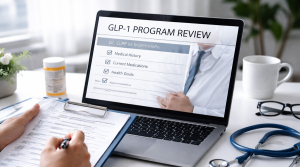
A GLP-1 intake review is the information collection stage used by online telehealth programs before any clinical evaluation. It gathers required disclosures, health history, and background details so intake data can be prepared for licensed clinician review. The intake review itself does not make medical decisions.
In an online GLP-1 intake review process, platforms collect structured intake forms and supporting disclosures. These materials are organized and routed for clinician consideration but are not an evaluation or prescribing step. Intake reviews focus on completeness, accuracy, and regulatory requirements.
Across GLP-1 telehealth intake form review workflows, the intake stage serves as an administrative and clinical handoff. It separates information collection from clinical judgment, prescribing authority, and treatment decisions.
1. What Does a GLP-1 Intake Review Usually Include?
A GLP-1 intake review typically refers to the standardized information collection process used before any medical evaluation occurs. Online telehealth programs use this stage to gather consistent baseline details required for regulatory, clinical, and administrative review.
Table 1: Common Information Collected During a GLP-1 Intake Review
The table below outlines the types of information commonly collected during a GLP-1 medical intake and why each category is gathered at this stage.
Information Type
Why It Is Collected During Intake
Personal identification and contact details
To establish identity, create a telehealth record, and meet basic documentation requirements.
Medical history disclosures
To provide background information required for later review by a licensed clinician.
Current medications and prior GLP-1 exposure
To supply clinical context for a future medical evaluation, if applicable.
Consent acknowledgments and legal attestations
To document required disclosures and confirm regulatory and telehealth compliance.
These inputs are collected in structured formats so they can be reviewed by licensed clinicians later. The intake review itself does not assess eligibility, approve treatment, or determine prescribing outcomes (NIH, 2023).
2. Who Reviews GLP-1 Intake Information?
GLP-1 intake information is reviewed by licensed clinicians, not by the telehealth platforms that collect it. Platforms are responsible for managing intake workflows, but they do not make clinical determinations based on the information submitted.
During a GLP-1 telehealth intake form review, responsibilities are typically divided as follows:
Telehealth platforms collect, organize, and transmit intake information
Licensed clinicians review intake information during a formal medical evaluation
This clinician review occurs only after intake is complete and is governed by state licensing rules, clinical standards, and professional judgment (Cleveland Clinic, 2024).
The intake review stage itself does not involve approval, denial, or treatment decisions and functions only as a preparatory step within regulatory and clinical boundaries.
Important Clarification. The collection of intake information by a telehealth platform does not constitute clinical review or approval. Medical assessment and decision-making occur only when a licensed clinician conducts a separate evaluation.
3. How Is a GLP-1 Intake Review Different From a Clinical Evaluation?
A GLP-1 intake review and a clinical evaluation serve different functions within online telehealth programs. The intake review focuses on collecting and organizing information, while the clinical evaluation involves medical assessment performed by a licensed clinician.
Table 2: GLP-1 Intake Review vs Clinical Evaluation
The table below contrasts the intake review stage with a clinical evaluation to clarify their separate roles.
Aspect
GLP-1 Intake Review
Clinical Evaluation
Primary purpose
Information collection and organization
Medical assessment and clinical judgment
Who performs it
Telehealth platform systems
Licensed clinician
Type of activity
Administrative and preparatory
Medical and evaluative
Medical decisions made
None
Possible, based on clinician judgment
Role in prescribing
Does not determine prescribing
May inform prescribing decisions
During intake, platforms gather disclosures, health history, and required acknowledgments. No clinical judgment is applied at this stage, and no determinations are made. The information is prepared so it can later be evaluated in a medical context.
A clinical evaluation occurs only after intake is complete. At that point, a licensed clinician reviews the intake information alongside clinical standards and professional judgment (Mayo Clinic, 2024). The intake review itself does not substitute for, influence, or predetermine the outcome of that evaluation.
4. What Does a GLP-1 Intake Review Not Determine?
A GLP-1 intake review does not determine clinical outcomes or treatment decisions. This stage exists to collect and organize information, not to assess medical eligibility or prescribing.
What the intake review does not determine includes:
Medical eligibility for GLP-1 treatment
Prescribing decisions or medication selection
Approval, denial, or qualification for care
Guarantees of medication access or ongoing treatment
Any medical decisions occur later during a formal evaluation conducted by a licensed clinician. The intake review remains separate from clinical judgment and does not establish participation in a specific program.
5. Why Do GLP-1 Intake Reviews Vary Across Programs?
GLP-1 intake reviews vary across programs because platforms operate under different administrative models, technology systems, and compliance approaches. While the purpose of intake remains consistent, the way information is collected and organized is not standardized across providers.
Variation commonly appears in how intake forms are structured, how much detail is requested, and how disclosures are presented. Some programs rely on shorter questionnaires, while others require more extensive documentation before intake is considered complete.
These differences reflect operational design choices rather than clinical standards. Regardless of format, intake reviews serve the same function of preparing information for licensed clinician review, not determining medical outcomes (NIH, 2023).
Important Clarification. Differences in intake length or format reflect platform design choices, not differences in clinical rigor. All medical evaluation and decision-making remain the responsibility of licensed clinicians, regardless of how intake information is collected.
6. What Are Common Misunderstandings About GLP-1 Intake Reviews?
GLP-1 intake reviews are often misunderstood because they occur early in the telehealth process. Common misconceptions include:
Intake functions as a medical evaluation or approval step
Completing intake guarantees medication access or ongoing care
Intake establishes eligibility or treatment plans
Telehealth platforms make medical judgments during intake
In practice, intake reviews only collect and organize information for later clinician review. Platforms manage data collection and workflow, while all clinical judgment remains the responsibility of licensed clinicians during separate evaluations.
7. What Does the GLP-1 Intake Review Stage Control and Not Control?
The GLP-1 intake review stage establishes clear process boundaries between information handling and medical decision-making. It defines what platforms manage during intake and what remains exclusively within clinician authority.
Table 3: What the GLP-1 Intake Review Stage Controls vs Does Not Control
The table below outlines what the intake review stage controls and what it does not control.
Intake Review Controls
Intake Review Does Not Control
Collection of intake forms and disclosures
Medical judgment or clinical assessment
Documentation and organization of intake data
Prescribing authority or treatment decisions
Verification of required acknowledgments
Eligibility determinations or approvals
Preparation of records for clinician review
Guarantees of medication access or care
All medical determinations occur later and rest solely with licensed clinicians. The intake review functions only as a preparatory step within a larger clinician-led evaluation system and does not influence clinical outcomes.
8. When Does a GLP-1 Intake Review Occur in the Overall Program Flow?
A GLP-1 intake review occurs early in the overall telehealth program flow. Its position in the process can be described as follows:
After enrollment or account creation
Before any clinical evaluation takes place
Before a licensed clinician reviews information medically
This stage functions as a prerequisite for later steps. Intake must be completed and documented before a clinical evaluation can occur, but it does not initiate or accelerate medical review on its own.
The timing of intake review reflects process dependency rather than clinical priority. It exists to ensure required information is available so clinician-led evaluation can proceed within regulatory and operational limits.
9. What Does This Intake Review Stage Ultimately Define?
The GLP-1 intake review stage defines how information enters an online telehealth program, not how care decisions are made. Its role is limited to documentation, disclosure collection, and preparation of records for later clinical use (NIMH, 2024).
This stage does not expand or limit clinician authority, alter medical standards, or create expectations about outcomes. All clinical decisions remain dependent on a separate medical evaluation conducted by a licensed clinician.
By design, the intake review establishes process clarity rather than medical direction. It exists to support regulatory compliance and clinician review while maintaining clear boundaries around what intake does and does not determine.
Sources:
National Institutes of Health (NIH). Telehealth and medical documentation standards. 2023.
Cleveland Clinic. Telehealth care delivery and clinical responsibility. 2024.
Mayo Clinic. Medical evaluation processes in telehealth settings. 2024.
National Institute of Mental Health (NIMH). Clinical review and provider responsibility guidance. 2024.
U.S. Department of Health and Human Services (HHS). Telehealth policy and compliance framework. 2024.