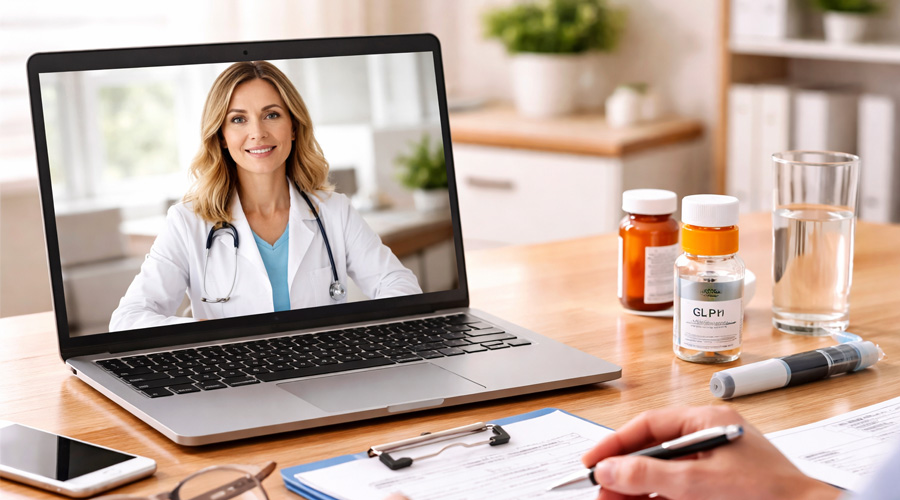
Online GLP-1 telehealth programs are frequently misunderstood as medical providers rather than support systems. This overview frames what these programs are designed to handle, where their authority ends, and why control boundaries matter before examining the details below.
Online GLP-1 telehealth programs typically include digital intake tools, clinician review workflows, and coordination with licensed pharmacies. They exclude medical guarantees, emergency care, and control over treatment decisions. Platforms support how online GLP-1 telehealth programs work but do not provide medical care.
These programs function as administrative and technical intermediaries within the telehealth system. They organize records, route information, and enable clinician communication. Licensed clinicians determine whether prescriptions are appropriate. Platforms do not decide outcomes or ensure access to medication.
What online GLP-1 programs include and exclude is shaped by telehealth law and safety rules. Program limitations and guarantees are clearly bounded. Clinical authority remains separate from platform operations.
1. What Is an Online GLP-1 Telehealth Program at a System Level?
At a system level, an online GLP-1 telehealth program is a digital service layer that supports remote care delivery. The program provides the technical and administrative structure needed for licensed clinicians to review information and communicate with patients.
These programs are built around software, workflows, and compliance processes. Core components usually include:
Secure medical intake forms
Digital medical record handling
Asynchronous or scheduled messaging systems
Coordination with pharmacy fulfillment partners
The platform itself does not diagnose, prescribe, or manage treatment. Its role is to enable telehealth interactions to occur within regulatory boundaries while keeping clinical authority with licensed clinicians (NIH, 2023).
Important Clarification. Platform access and program enrollment do not constitute medical care or clinical approval. All medical determinations, including prescribing decisions, are made independently by licensed clinicians.
2. Who Controls Medical Decisions Versus Platform Operations in These Programs?
Medical decisions within online GLP-1 telehealth programs are controlled by licensed clinicians. Clinicians review medical intake information, determine clinical appropriateness, and decide whether a prescription is issued.
Table 1. Division of Responsibilities Between Platforms and Licensed Clinicians
Function or responsibility
Platform role
Licensed clinician role
Medical intake collection
Collects and stores submitted information through digital intake systems
Reviews intake information for clinical relevance
Medical record management
Maintains digital records, access controls, and system security
Uses records to inform clinical judgment
Diagnosis determination
Does not perform diagnostic assessment
Determines diagnoses when clinically appropriate
Prescribing decisions
Is not permitted to issue or approve prescriptions
Decides whether a prescription is issued
Treatment planning
Does not create or manage treatment plans
Establishes and adjusts treatment plans
Patient communication
Provides messaging, scheduling, and communication tools
Conducts clinical communication with patients
Safety and accountability
Implements system safeguards and compliance controls
Holds medical responsibility and clinical accountability
The platform controls non-clinical operations and system functions. These typically include intake collection, record storage, scheduling tools, and communication infrastructure. Platforms may route information but do not interpret it clinically.
This separation is required by medical licensing rules. It prevents platforms from practicing medicine and preserves clinician accountability for all treatment-related decisions (Cleveland Clinic, 2024).
Important Clarification. Platform tools and workflows support clinician review but do not replace or influence independent medical judgment. Prescribing authority and clinical responsibility remain solely with licensed clinicians.
3. What Information Do Online GLP-1 Programs Typically Collect and Review?
Online GLP-1 telehealth programs typically collect structured medical intake information. This information is gathered to support clinician review rather than to make automated decisions.
Table 2. Types of Information Collected and How It Is Used
Information type
Collected by platform
Reviewed by clinician
Purpose of collection
Health history details
Yes
Yes
Provides background context for clinical review
Current medications
Yes
Yes
Identifies potential interactions or conflicts
Self-reported measurements
Yes
Yes
Supplies baseline information for assessment
Identity verification
Yes
No
Confirms user identity for telehealth compliance
Consent acknowledgments
Yes
No
Documents legal and regulatory consent
Communication records
Yes
Yes
Supports continuity and documentation
The platform organizes and transmits this information. Licensed clinicians review the content and determine its clinical relevance. The platform does not assess medical risk or determine eligibility (NIH, 2023).
4. What Do Online GLP-1 Programs Not Provide or Guarantee?
Online GLP-1 telehealth programs do not provide medical guarantees. They do not promise prescriptions, specific medications, clinical outcomes, or continued access to treatment.
Table 3. Services and Outcomes That Are Not Provided or Guaranteed
Item or capability
Included
Not provided or guaranteed
Prescription approval
No
Not guaranteed
Specific medication access
No
Not guaranteed
Clinical outcomes
No
Not guaranteed
Ongoing treatment continuity
No
Not guaranteed
Emergency medical care
No
Not provided
Acute condition management
No
Not provided
Real-time clinical monitoring
No
Not provided
Diagnosis determination
No
Not provided
Treatment plan control
No
Not provided
These programs do not offer emergency care, acute medical management, or real-time clinical monitoring. They are not designed to replace in-person medical services or manage urgent health needs (Mayo Clinic, 2024).
Program platforms also do not determine diagnoses or treatment plans. All clinical judgments remain with licensed clinicians, and participation is not assured.
Important Clarification. Program access, prior participation, or completion of intake steps does not create an obligation to prescribe medication or continue treatment. Clinical decisions may change based on clinician review and patient circumstances.
5. Why Do Online GLP-1 Program Structures Vary Across Providers?
Online GLP-1 program structures vary because platforms operate within different business models and clinical partnerships. Each program designs workflows based on how clinicians, pharmacies, and technology vendors are contracted.
Key drivers of structural variation include:
Differences in clinical partnership arrangements
State telehealth and prescribing requirements
Pharmacy coordination and fulfillment models
Technology and compliance infrastructure choices
Despite surface differences, the underlying separation of roles remains consistent. Platforms manage systems and logistics, while licensed clinicians retain authority over medical decisions.
6. How Do Regulatory and Safety Limits Shape How These Programs Operate?
Regulatory and safety limits strongly shape how online GLP-1 telehealth programs are designed. Telehealth laws define what platforms may manage and what actions require licensed clinical authority.
Table 4. Key Regulatory Areas and Their Operational Impact on Program Design
Regulatory area
What it restricts
How programs are structured in response
Medical licensing
Diagnosis and prescribing authority
Clinical decisions are assigned only to licensed clinicians
Telehealth rules
Scope of remote care delivery
Platforms provide communication and documentation tools
Privacy laws
Handling of health information
Systems use secure storage and controlled access
Pharmacy regulation
Medication dispensing and sourcing
Fulfillment occurs through regulated pharmacies
Consumer protection
Claims and representations
Programs avoid guarantees or outcome promises
Key regulatory limits that shape program operations include:
Medical licensing rules that restrict diagnosis, prescribing, and treatment decisions to clinicians
Privacy laws that govern how health information is collected, stored, and transmitted
These limits exist to reduce patient risk and ensure accountability. As a result, platforms are structured to support care delivery without exercising medical judgment (NIH, 2023).
7. What Are Common Misunderstandings About the Role of GLP-1 Telehealth Platforms?
Common misunderstandings about the role of GLP-1 telehealth platforms include:
The belief that platforms act as medical providers or deliver clinical care
The assumption that enrollment guarantees medication access or ongoing treatment
The idea that platforms oversee clinical safety monitoring
In practice, platforms do not deliver care or make treatment decisions. Clinical oversight and accountability remain the responsibility of licensed clinicians, not the technology or administrative system.
Important Clarification. Educational content, platform messaging, or automated workflows do not substitute for clinical evaluation. Medical decisions are made by licensed clinicians based on individual review, not by the platform itself.
8. Where Does the Operational Responsibility of an Online GLP-1 Program End?
The operational responsibility of an online GLP-1 program ends at system support and care coordination functions. Platforms provide tools for intake, communication, and record handling but do not extend beyond those functions.
Clinical decisions, prescribing authority, and patient care remain outside platform control. These responsibilities belong solely to licensed clinicians and regulated pharmacies.
This boundary defines the scope of what these programs do and do not determine. It reinforces that medical authority and accountability are not transferred to the platform (Cleveland Clinic, 2024).
Sources:
National Institutes of Health (NIH). Telehealth and health information oversight. 2023. https://www.nih.gov/health-information/telehealth
Cleveland Clinic. Telehealth roles, limits, and clinical responsibility. 2024. https://health.clevelandclinic.org/what-is-telehealth
Mayo Clinic. Telemedicine scope and emergency care limitations. 2024. https://www.mayoclinic.org/healthy-lifestyle/consumer-health/in-depth/telemedicine/art-20044878
U.S. Department of Health and Human Services (HHS). What is telehealth. https://telehealth.hhs.gov/patients/understanding-telehealth