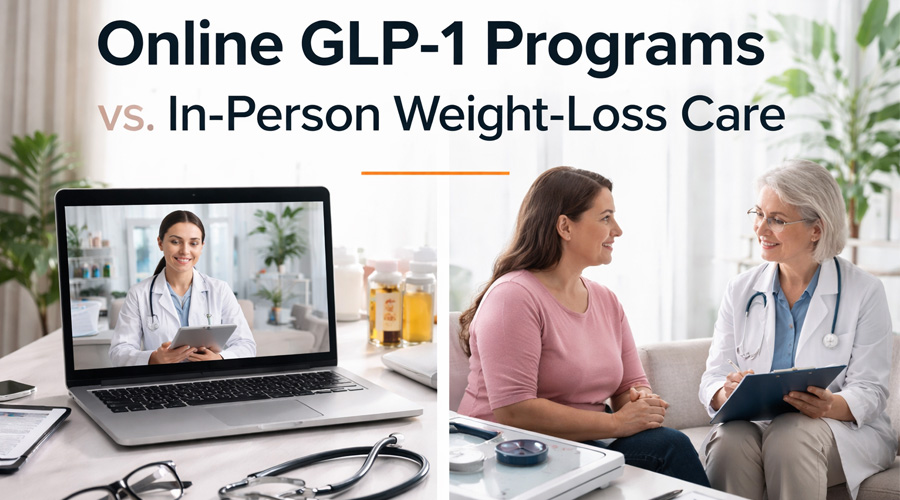
Online GLP-1 programs and in-person weight-loss care are commonly treated as alternatives, but they operate through very different delivery models. Understanding how structure, access, and coordination differ helps explain why the overall experiences are not the same.
Online GLP-1 programs and in-person weight-loss care differ mainly in how care is delivered and coordinated. Online programs rely on remote intake, asynchronous communication, and platform-based workflows. In-person care centers on face-to-face visits, scheduled appointments, and physical clinic settings.
When comparing online GLP-1 programs with in-person care, the distinction is structural rather than clinical. Online models emphasize digital access and distributed touchpoints. In-person models emphasize location-based care and direct interaction during visits.
These format differences shape access, cadence, and the overall experience. They do not determine medical decisions, which remain the responsibility of licensed clinicians in both settings.
1. Structure of Online GLP-1 Programs vs In-Person Weight-Loss Car
Online GLP-1 programs and in-person weight-loss care are built around different delivery structures. The distinction starts with where coordination happens and how care workflows are organized.
Table 1. Core Structural Elements by Care Format
Structural element
Online GLP-1 programs
In-person weight-loss care
Coordination environment
Centralized digital platforms manage intake and communication
Physical clinic locations where care is delivered
Workflow routing
Tasks distributed across remote clinicians and support systems
On-site appointments for evaluations and follow-up
Separation of roles
Platform coordination is separate from clinical decision-making
Administrative and clinical processes handled within the same facility
These structural differences shape how care is accessed and experienced across formats. They reflect format design choices rather than differences in clinical authority or decision-making (NIH, 2023).
2. Care Delivery and Access Differences Between Online GLP-1 Programs and Clinics
The delivery setting is one of the clearest differences between online GLP-1 programs and in-person weight-loss care. Each format defines access in distinct ways.
Table 2. Delivery Setting and Access Differences
Attribute
Online GLP-1 programs
In-person weight-loss care
Primary delivery setting
Remote, platform-based environments
Physical clinic locations
Location dependence
Not tied to a single clinic location
Tied to a specific practice location
Appointment structure
May occur without scheduled office visits
Typically requires scheduled visits
Geographic constraints
Less dependent on proximity
Dependent on travel and office hours
Online GLP-1 programs deliver care remotely. Medical intake, clinician review, and follow-up communication occur through digital systems. Access is typically not tied to a single location, and interactions may happen without scheduled office visits.
In-person weight-loss care is delivered at a physical clinic. Access usually depends on appointment availability, office hours, and geographic proximity. Care interactions occur during scheduled visits at the clinic location (Mayo Clinic, 2024).
Important Clarification
These access models influence how often interactions occur and how they are scheduled. They reflect logistical design choices rather than differences in clinical standards.
3. Communication and Interaction Models in Online GLP-1 Programs vs In-Person Care
Interaction patterns differ noticeably between online GLP-1 programs and in-person weight-loss care. These differences affect how communication occurs and how often contact takes place.
Table 3. Communication Format and Interaction Cadence
Attribute
Online GLP-1 programs
In-person weight-loss care
Primary communication format
Digital messaging and portals
Face-to-face conversations
Timing of interaction
Often asynchronous
Real-time during visits
Contact cadence
Distributed over time
Concentrated around appointments
Location of communication
Platform-based environments
Clinic setting
Online GLP-1 programs commonly use asynchronous communication. Messages, forms, and updates are exchanged through portals or apps. Responses may occur outside of real-time conversations and are often spaced across days.
In-person weight-loss care relies more on scheduled, real-time interactions. Communication typically happens during appointments, with limited contact between visits. Follow-up discussions often wait until the next scheduled session (Cleveland Clinic, 2024).
Important Clarification
These interaction models influence communication cadence and expectations. They reflect format design choices rather than differences in clinician involvement or oversight.
4. Enrollment and Care Process Flow for Online GLP-1 Programs vs Clinics
Enrollment processes differ between online GLP-1 programs and in-person weight-loss care. These differences shape how individuals move from initial contact to ongoing participation.
Table 4. Enrollment and Ongoing Process Flow by Format
Process stage
Online GLP-1 programs
In-person weight-loss care
Initial contact
Completion of a digital medical intake through the platform
An initial office visit at a clinic location
Clinical review
Remote review of intake information by a licensed clinician
Intake, evaluation, and discussion during the appointment
Ongoing coordination
Follow-up and updates managed through platform systems
Ongoing care structured around future scheduled visits
These process flows influence timing and coordination across care formats. They reflect operational design rather than differences in clinical review standards (NIH, 2023).
5. Continuity of Care and Follow-Up in Online GLP-1 Programs vs In-Person Care
Continuity of care is handled differently in online GLP-1 programs and in-person weight-loss care. These differences relate to how follow-up is organized and what each format manages directly.
Table 5. Continuity and Follow-Up Mechanisms by Format
Continuity mechanism
Online GLP-1 programs
In-person weight-loss care
Ongoing access
Platform access used for check-ins and updates
Repeat clinic appointments with the same practice
Follow-up structure
Administrative and coordination tasks routed digitally
Follow-up conducted during scheduled in-person visits
Record management
Care continuity based on platform workflows
Records and coordination maintained within the clinic system
In both formats, licensed clinicians retain control over medical decisions. Platforms and clinics manage logistics, not clinical judgment (APA, DSM-5-TR).
6. Patient Experience Differences Between Online GLP-1 Programs and Clinics
The overall experience of care often feels different between online GLP-1 programs and in-person weight-loss care settings. These differences stem from format design rather than clinical intent.
Table 6. General Experience Characteristics by Care Format
Experience aspect
Online GLP-1 programs
In-person weight-loss care
Interaction style
Platform-led interactions through dashboards, messages, and notifications
Visit-centered engagement within a clinic environment
Primary touchpoints
Digital touchpoints rather than physical visits
Direct interaction with staff during scheduled appointments
Care rhythm
Ongoing awareness of care through system updates and prompts
Care rhythm defined by time spent on site
These experiential differences influence expectations and pacing over time. They reflect how care is delivered, not how medical decisions are made (Mayo Clinic, 2024).
7. Platform vs Clinician Roles in Online GLP-1 Programs and In-Person Care
Online GLP-1 programs and in-person weight-loss care each operate within defined limits. These limits clarify what the format manages versus what remains outside its control.
Table 7. Operational Responsibilities and Control Boundaries
Responsibility area
Online GLP-1 programs
In-person weight-loss care
Care coordination
Managed through digital platforms
Managed through clinic systems
Communication tools
Platform-based messaging and portals
In-clinic conversations and phone contact
Clinical decision-making
Controlled by licensed clinicians, not platforms
Controlled by clinicians within the practice
Prescribing authority
Determined by licensed clinicians
Determined by licensed clinicians
Pharmacy fulfillment
Handled by external licensed pharmacies
May be handled by affiliated or external pharmacies
Online GLP-1 programs typically manage platform access, coordination, and communication tools. They do not control clinician decisions, medical eligibility, or prescribing outcomes. Pharmacy fulfillment and clinical judgment occur through separate licensed entities.
In-person weight-loss care manages clinic operations, scheduling, and on-site coordination. Medical decisions are made by clinicians within the practice. Administrative systems support care but do not replace clinical authority.
Important Clarification
Platform coordination and program participation do not equate to clinical approval or guaranteed eligibility. Medical decisions, including prescribing, remain the independent responsibility of licensed clinicians.
These non-overlapping roles are central to both formats. They help explain differences in experience without implying differences in medical responsibility (NIH, 2023).
8. Why Online GLP-1 Programs and In-Person Clinics Use Different Care Models
Online GLP-1 programs and in-person weight-loss care are often described as different care models because their formats are designed for different delivery environments.
Online GLP-1 programs are built to operate across locations using digital infrastructure. Coordination, communication, and administrative processes are separated from physical space. The model supports remote access and distributed participation.
In-person weight-loss care is built around location-based delivery. Clinical encounters, administrative tasks, and follow-up are centered within a single practice setting. The model emphasizes in-person interaction as the primary organizing feature.
These framing differences help explain how each format functions in practice. They do not indicate differences in clinical standards or medical responsibility.
Important Clarification
Online GLP-1 programs provide platform access, coordination, and administrative support. They do not grant clinical approval, determine medical eligibility, or control prescribing decisions, which are made independently by licensed clinicians.
9. Summary of Key Differences Between Online GLP-1 Programs and In-Person Care
Online GLP-1 programs and in-person weight-loss care are commonly compared based on format, not outcomes. The differences center on delivery setting, interaction cadence, and coordination structure.
Online GLP-1 programs emphasize remote access, platform-based workflows, and distributed communication. In-person weight-loss care emphasizes physical locations, scheduled visits, and on-site coordination.
These distinctions help explain why the two formats often feel different in practice. They describe how care is organized and delivered, while medical decisions remain clinician-led in both models (NIMH, 2024).
Sources:
National Institutes of Health. (2023). Telehealth and care delivery models.
Mayo Clinic. (2024). In-person care, appointments, and continuity of care.
Cleveland Clinic. (2024). Patient communication and follow-up in clinical settings.
American Psychiatric Association. (DSM-5-TR). Clinical authority and diagnostic responsibility.
National Institute of Mental Health. (2024). Healthcare delivery roles and clinical oversight.