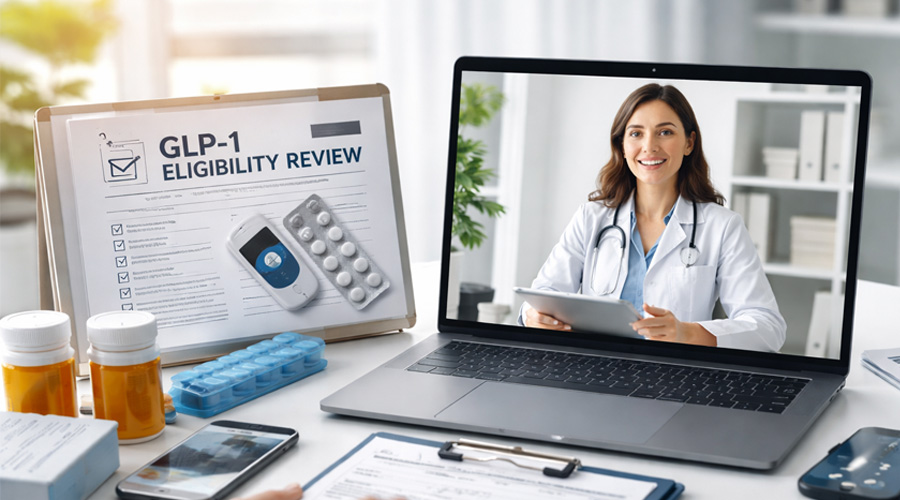
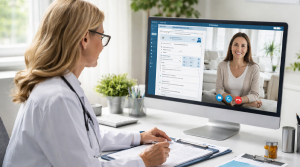
Online GLP-1 eligibility reviews can appear simple on the surface, but the underlying process involves clear role separation, defined limits, and clinical authority. Understanding where platforms stop and clinicians begin helps explain why eligibility decisions vary and what the process does not determine.
Eligibility in online GLP-1 telehealth programs is determined through a clinician-led review process supported by a digital platform. Medical information is collected through an online intake, then evaluated by a licensed clinician who makes the eligibility decision. Platforms facilitate the process but do not determine eligibility.
This online GLP-1 eligibility determination process is structured to separate technology from medical judgment. Platforms manage intake systems, records, and communication tools. Licensed clinicians conduct the GLP-1 telehealth eligibility review and retain full authority over medical decisions.
How online GLP-1 programs decide eligibility can vary by provider. Differences reflect clinician policies, regulatory interpretation, and operational design. A GLP-1 program eligibility screening process does not guarantee approval, prescribing, or ongoing access.
1. What Is an Online GLP-1 Telehealth Program, and How Is It Structured?
An online GLP-1 telehealth program is a coordinated system that connects digital platforms with licensed clinicians. The platform provides the technical infrastructure for program operations. Clinical care decisions remain separate from the platform and are made by licensed clinicians (NIH, 2023).
Most programs share a similar structural foundation. Common components include:
A web-based medical intake system
Secure record storage and communication tools
Access to a licensed clinician network
Coordination with pharmacy fulfillment partners
This structure allows medical review to occur remotely while maintaining clinician authority. The platform organizes information and workflow. It does not replace medical judgment or automate eligibility decisions.
Important Clarification. Platform access, account creation, or intake completion does not constitute clinical approval. Eligibility and prescribing decisions are made independently by licensed clinicians, not by the telehealth platform.
2. Who Actually Determines Eligibility and Prescribing in These Programs?
Eligibility and prescribing decisions in online GLP-1 telehealth programs are made by licensed clinicians. Their responsibilities include:
Reviewing submitted medical information
Determining eligibility and prescribing within professional judgment
Maintaining medical authority throughout the GLP-1 telehealth eligibility review
Telehealth platforms do not practice medicine and do not approve or deny care. Platform responsibilities are limited to access and workflow support, not medical decisions.
This separation is a core compliance feature of U.S. telehealth models (Cleveland Clinic, 2024). It ensures that eligibility decisions reflect clinical standards rather than platform policies or automated rules.
3. What Does the Telehealth Platform Manage Versus the Clinician?
Online GLP-1 telehealth programs rely on a clear division of responsibilities between platforms and clinicians. Each party manages different parts of the system, which helps maintain regulatory compliance and clinical independence.
Table 1. Platform responsibilities vs clinician responsibilities
Entity
Primary role
What it controls
What it does not control
Telehealth platform
Technology infrastructure and program coordination
Digital medical intake tools, user accounts, identity verification, secure data storage, messaging systems
Review of medical information, eligibility determination, prescribing decisions, clinical oversight
Platform operations, user account management, technical infrastructure
This division limits platform involvement in medical judgment. It also clarifies that eligibility decisions are not made by software, algorithms, or administrative staff.
4. What Types of Information Are Typically Used to Review Eligibility?
Online GLP-1 telehealth programs rely on medical information collected through standardized digital intake processes (NIH, 2023). This information provides clinicians with the context needed to conduct an eligibility review. The platform’s role is limited to collecting and organizing this data.
Information used in a GLP-1 telehealth eligibility review is typically grouped into broad categories:
Self-reported medical history and health background
Current medications and prior treatments
Basic biometric or demographic information
Program-specific disclosures required for telehealth use
The scope and format of this information can vary by provider. Clinicians determine how the information is weighed. Platforms do not interpret responses or apply eligibility rules.
Important Clarification. Information collected during medical intake supports clinician review but does not function as an automatic qualification system. Individual responses are not scored, weighted, or approved by the platform, and no single data point determines eligibility.
5. What Does Eligibility Determination Not Guarantee or Decide?
Eligibility determination in online GLP-1 telehealth programs has defined limits. A clinician’s review establishes whether treatment may be considered. It does not promise approval, prescribing, medication access, or continuation of care.
Table 2. What eligibility review covers vs what it does not determine
What eligibility review covers
What eligibility review does not determine
Clinical assessment by a licensed clinician
Whether a prescription will be issued
Review of submitted medical information
Whether medication will be dispensed by a pharmacy
Determination of potential treatment appropriateness
Whether treatment will continue over time
Documentation of clinical decision-making
Whether program participation remains available
These limits exist because medical decisions remain dynamic (Mayo Clinic, 2024). Clinicians may reassess eligibility as information changes. Platforms do not override, finalize, or guarantee any medical outcome.
Important Clarification. An eligibility review reflects a point-in-time clinical assessment. It does not create a right to treatment, medication access, or continued participation, and it may be reassessed by a licensed clinician as circumstances change.
6. Why Does Eligibility and Program Structure Vary Between Providers?
Eligibility determination and program structure can vary across online GLP-1 telehealth programs. These differences exist even when programs appear similar on the surface. Variation is a structural feature, not an exception.
Several factors commonly drive this variability.
Table 3. Sources of program variation and what typically differs
Source of variation
What typically differs
Clinician networks
How professional judgment is applied during eligibility review
Telehealth compliance implementation
How regulatory requirements are operationalized
Internal medical policies
How reviews are structured and documented
Platform design choices
How intake, communication, and workflow are supported
Because clinicians retain decision-making authority, eligibility outcomes are not standardized across programs. Platforms may support different models, but they do not impose uniform eligibility rules.
7. What Are Common Misunderstandings About How Online GLP-1 Programs Work?
Online GLP-1 telehealth programs are sometimes misunderstood because their digital interfaces resemble automated services. This can lead to incorrect assumptions about how eligibility decisions are made and who controls them.
Several misunderstandings appear frequently.
Table 4. Common assumptions vs how online GLP-1 programs actually operate
Common assumption
How the system actually works
Eligibility decisions are automated or instant
Licensed clinicians review information before making eligibility decisions
Platforms approve or deny care directly
Platforms facilitate access but do not make medical decisions
Completing an intake guarantees treatment access
Intake submission does not guarantee approval or prescribing
Program rules override clinician judgment
Clinician judgment supersedes platform processes
These assumptions do not reflect how the system operates. Licensed clinicians retain authority over medical decisions. Platforms provide structure and access, but they do not determine eligibility decisions or outcomes.
Important Clarification. A digital interface or streamlined workflow does not indicate automated medical decision-making. Eligibility and prescribing decisions remain clinician-driven, even when program interactions appear fully online.
8. How Do Online GLP-1 Programs Fit Into the Broader U.S. Telehealth Model?
Online GLP-1 programs operate within the same regulatory framework as other U.S. telehealth services (NIH, 2023). They are designed to extend access to clinician review through remote systems rather than replace in-person medical authority.
These programs typically reflect broader telehealth norms:
Licensed clinicians practice within state-based medical regulations
Platforms function as technology and coordination layers
Medical decisions follow established telehealth standards
This alignment explains why eligibility review mirrors other telehealth models. Digital access changes how care is delivered, not who controls medical decisions or how those decisions are made.
9. What Are the Scope Limits and Authority Boundaries of These Programs?
This article explains how eligibility is typically determined within online GLP-1 telehealth programs. It describes system structure, role separation, and review boundaries. It does not describe medical criteria, approval logic, or treatment decisions.
Eligibility determination remains a clinical function performed by licensed clinicians. Platforms provide access, organization, and technical support functions. They do not control medical judgment, guarantee outcomes, or replace clinician authority.
These boundaries define how online GLP-1 telehealth programs operate. They clarify what the system can explain and what remains dependent on individual clinical review.
Sources:
National Institutes of Health (NIH). Telehealth and clinical decision-making overview. 2023.
Cleveland Clinic. Telehealth care models and clinician authority. 2024.
Mayo Clinic. Clinical assessment, reassessment, and continuity of care. 2024.
U.S. Department of Health and Human Services (HHS). Telehealth policy and regulatory framework. 2023.
Food and Drug Administration (FDA). Telemedicine and remote prescribing overview. 2023.