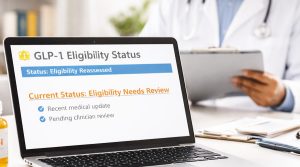
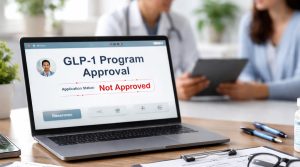
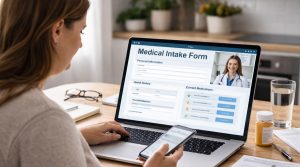
Eligibility in GLP-1 telehealth programs is shaped by medical authority, not enrollment steps. This article explains where eligibility decisions actually occur, why guarantees are not allowed, and how platform roles differ from clinical judgment.
Eligibility is not guaranteed in GLP-1 telehealth programs because enrollment does not equal clinical approval. A licensed clinician reviews each medical intake and decides eligibility independently. Telehealth platforms manage access and administration, but they do not control prescribing decisions or clinical outcomes.
In the GLP-1 telehealth eligibility approval process, online programs collect information and route it for clinical review. Approval depends on professional judgment, regulatory standards, and current medical context. No GLP-1 telehealth program can promise eligibility in advance.
This structure explains why GLP-1 telehealth approval is not guaranteed. The GLP-1 telehealth program eligibility review remains clinician-led, with platforms limited to coordination and system support.
1. What Does “Eligibility” Actually Mean in GLP-1 Telehealth Programs?
In GLP-1 telehealth programs, eligibility refers to a clinical determination made during clinical review. It exists only after a licensed clinician evaluates submitted health information.
Eligibility does not include the following:
Account creation or platform enrollment status.
Payment or subscription confirmation.
Completion of intake forms alone.
This evaluation focuses on whether prescribing can occur within professional and regulatory boundaries. Although the term appears broadly in marketing, operationally it applies to clinician judgment. Platforms cannot define eligibility independently.
Because eligibility is clinician-based, it can change over time. Each review reflects the information available at that moment and the standards governing medical practice (NIH, 2023).
2. Who Decides Eligibility in Online GLP-1 Programs?
Eligibility decisions in GLP-1 telehealth programs are made by licensed clinicians. These clinicians are responsible for reviewing medical intake information and determining whether prescribing is appropriate.
In this structure:
Licensed clinicians evaluate medical information and make eligibility determinations.
Telehealth platforms provide technology, intake tools, and administrative coordination.
Platforms do not approve, deny, or influence medical decisions.
This division of responsibility is required for regulatory compliance. It ensures that eligibility remains a medical determination rather than a platform-controlled outcome (Cleveland Clinic, 2024).
Important Clarification. Telehealth platforms do not make eligibility or prescribing decisions. Eligibility is determined solely by licensed clinicians based on clinical review, not by the platform providing access or technology.
3. What Information Is Reviewed When Eligibility Is Evaluated?
When eligibility is evaluated, GLP-1 telehealth programs collect information through a medical intake process. This information is submitted for clinician review, not automated approval. The intake is designed to support medical assessment, not guarantee access.
Table 1. Information Commonly Reviewed During GLP-1 Telehealth Eligibility Evaluation
Information category
How it is used in review
Who reviews it
Health history
Provides background context for clinical judgment
Licensed clinician
Current conditions
Helps assess medical appropriateness at review time
Licensed clinician
Medication use
Identifies potential interactions or considerations
Licensed clinician
Intake questionnaires
Clarifies reported information and symptoms
Licensed clinician
Follow-up clarification
Resolves gaps or inconsistencies in submissions
Licensed clinician
The completeness and accuracy of submitted information affect review. Eligibility decisions are based on what is available at the time of evaluation, not assumptions or prior enrollment status (Mayo Clinic, 2024).
4. What Do GLP-1 Telehealth Platforms Control vs. What Do They Not Control?
GLP-1 telehealth platforms manage the administrative and technical structure that enables access to clinical review. These functions support coordination and communication, but they do not involve clinical judgment or decision-making.
Table 2. Division of Control Between GLP-1 Telehealth Platforms and Clinicians
Function area
Platform role
Clinician role
Account setup
Creates and maintains user accounts
Not involved
Medical intake
Collects and transmits intake information
Reviews submitted information
Payments and billing
Processes program and service fees
Not involved
Messaging tools
Enables secure communication channels
Uses tools for clinical communication
Eligibility decisions
No authority or control
Makes final determination
Prescribing
No authority or control
Issues or withholds prescriptions
Platforms do not control eligibility determinations, prescribing decisions, or clinical approvals. Those actions are reserved for licensed clinicians under professional and regulatory standards.
This separation limits what programs can promise. It also explains why eligibility outcomes cannot be standardized or guaranteed across platforms.
Important Clarification. Platform-managed services such as intake collection, payments, and messaging do not include control over eligibility decisions or prescriptions, which remain the responsibility of licensed clinicians.
GLP-1 telehealth programs cannot promise approval because medical decisions must remain independent. Licensed clinicians are required to evaluate each case individually.
Approval cannot be promised in advance because:
Medical decisions must follow professional standards and ethics.
Clinicians must apply judgment based on the information reviewed.
Eligibility depends on clinician judgment at the time of review. That judgment may reflect medical context, evolving guidance, and the information provided.
As a result, approval cannot be guaranteed before review occurs. This limitation applies across compliant GLP-1 telehealth programs, regardless of how enrollment or marketing language is presented.
Important Clarification. Approval cannot be promised before clinical review occurs. Eligibility is determined only after a licensed clinician evaluates submitted information and applies professional and regulatory standards.
6. Why Does Eligibility Differ Between GLP-1 Telehealth Programs?
Eligibility can differ between GLP-1 telehealth programs because programs operate under varying structures. These differences affect how information is collected, reviewed, and communicated. They do not change who makes the medical decision.
Table 3. Structural Sources of Eligibility Variability Across GLP-1 Telehealth Programs
Source of variation
What varies across programs
What does not change
Intake design
Format and depth of intake questions
Clinician authority over decisions
Review workflow
How information is routed or clarified
Requirement for clinical review
State practice rules
Licensing scope and oversight context
Use of licensed clinicians
Communication processes
Timing and method of follow-up
Independent medical judgment
Clinicians may practice under different state rules, oversight arrangements, or clinical workflows. Programs also vary in intake design and follow-up processes. These factors shape how eligibility reviews occur.
As a result, outcomes are not uniform across programs. Variability reflects system design and clinical discretion, not platform promises or guarantees (NIH, 2023).
7. Why Do Many People Assume Eligibility Is Automatic?
Many people assume eligibility is automatic because enrollment steps resemble subscription services. Account creation, payment, and intake completion can appear final. These steps, however, occur before any medical decision is made.
Table 4. Common Eligibility Assumptions vs Operational Reality in GLP-1 Telehealth Programs
Common assumption
What actually occurs
Enrollment means approval
Enrollment only begins the clinical review process
Payment confirms eligibility
Payment covers access and administration, not approval
Intake completion is final
Intake information is reviewed by a licensed clinician
Prior use guarantees access
Each review is independent and time-specific
Marketing language and simplified workflows can also blur distinctions. Terms like enrollment or getting started are often interpreted as approval. Operationally, they only signal entry into review.
This misunderstanding is common across GLP-1 telehealth programs. It reflects platform design choices, not a guarantee of eligibility or prescribing.
8. How Do Regulatory and Clinical Uncertainty Affect Eligibility Decisions?
Regulatory and clinical uncertainty affects eligibility because guidance and oversight can change. Clinicians must account for current conditions at the time of review.
Sources of regulatory uncertainty include:
Changes in applicable rules or guidance.
State-specific licensing requirements.
Evolving professional standards.
Clinical uncertainty also plays a role. Medical information may be incomplete, evolving, or require clarification. Clinicians may delay or limit decisions until sufficient information is available.
Because these conditions are not fixed, eligibility outcomes cannot be predicted in advance. Uncertainty reinforces why approval is never guaranteed in GLP-1 telehealth programs (Mayo Clinic, 2024).
9. What Are the Final Limits of Eligibility Determination in GLP-1 Telehealth Programs?
Eligibility determination in GLP-1 telehealth programs is limited to clinical review at a specific point in time. It does not create an ongoing guarantee, entitlement, or obligation to prescribe. Each decision applies only to the reviewed submission.
Telehealth platforms cannot expand or override clinician authority. They also cannot convert prior approval into permanent eligibility. Changes in information, rules, or clinical judgment may alter future determinations.
These boundaries define how eligibility works in practice. The process is clinician-led, review-based, and inherently non-guaranteed (NIH, 2023).
Sources:
National Institutes of Health (NIH). Clinical decision-making and medical review standards. https://www.nih.gov/health-information
Mayo Clinic. Telehealth care, medical evaluation, and prescribing principles. https://www.mayoclinic.org/healthy-lifestyle/consumer-health/in-depth/telehealth/art-20044878
Cleveland Clinic. Telemedicine basics and physician responsibility in virtual care. https://my.clevelandclinic.org/health/articles/telemedicine-basics
U.S. Department of Health & Human Services (HHS). What is telehealth. https://telehealth.hhs.gov/patients/understanding-telehealth
Federation of State Medical Boards (FSMB). Telemedicine and state medical licensure. https://www.fsmb.org/advocacy/telemedicine/