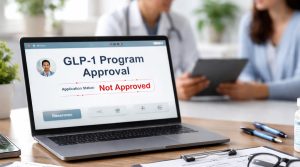
Medical review is a required but frequently misunderstood step in online GLP-1 telehealth programs. This article documents what medical review actually covers, who controls it, and where its authority ends within program operations.
Medical review in GLP-1 programs is the clinician-led assessment of intake information to determine whether care can be considered through a telehealth GLP-1 program. In online GLP-1 medical review processes, this step verifies clinical context before any prescribing decisions occur.
In telehealth GLP-1 programs, medical review is performed by a licensed clinician, not the platform itself. The platform collects information and routes it for review, but does not control or finalize clinical judgments.
Medical review is distinct from intake and from full clinical evaluation. It does not guarantee eligibility, approval, or medication access, and it does not replace ongoing clinician oversight once care is established.
1. What Does “Medical Review” Mean in Online GLP-1 Telehealth Programs?
In online GLP-1 telehealth programs, medical review refers to a defined clinical checkpoint within the program enrollment process. It is the stage where submitted intake information is examined by a licensed clinician.
This step serves several specific functions within the program:
Confirms intake information is medically relevant for telehealth review
Checks that submitted information is complete enough for clinical consideration
Establishes whether a clinical evaluation can proceed under telehealth rules
Medical review does not involve treatment planning or prescribing. It exists to determine whether further clinical evaluation is appropriate within program and regulatory limits (NIH, 2023).
Important Clarification. Medical review confirms that intake information can be assessed by a licensed clinician within a telehealth program. It does not represent clinical approval, treatment authorization, or a guarantee of program participation.
2. Who Actually Performs the Medical Review in GLP-1 Programs?
Medical review in GLP-1 telehealth programs is performed by a licensed clinician who is authorized to practice within the applicable state of care (Cleveland Clinic, 2024). This clinician is responsible for reviewing intake information from a medical perspective.
Table 1. Roles Involved in the Medical Review Process
Role
What this role does during medical review
Licensed clinician
Reviews intake information for medical relevance and completeness within a telehealth setting.
Telehealth platform
Collects intake data, standardizes presentation, and routes information to the clinician.
Administrative systems
Support documentation, scheduling, and record handling without making clinical decisions.
The telehealth platform itself does not conduct the medical review. Its role is limited to collecting information, presenting it in a standardized format, and routing it to the clinician.
Clinical responsibility for medical review rests with the reviewing clinician. Platforms do not approve, deny, or override clinical determinations made during this stage.
Important Clarification. Platform access, account creation, or enrollment status does not equate to clinical approval. Medical review and all related clinical judgments are performed independently by licensed clinicians, not by the telehealth platform.
3. How Is Medical Review Different From Intake Forms and Clinical Evaluation?
Medical intake, medical review, and clinical evaluation are separate steps that serve distinct roles within GLP-1 telehealth programs (Mayo Clinic, 2024).
Table 2. How Intake, Medical Review, and Clinical Evaluation Differ
Process stage
What this step involves
Who performs it
What it does not do
Medical intake
Collection of health and background information through standardized forms.
Individual and platform systems
Does not assess, evaluate, or make clinical judgments.
Medical review
Clinician examination of submitted intake information for relevance and completeness.
Licensed clinician
Does not determine eligibility, prescribe medication, or create a treatment plan.
Clinical evaluation
Broader clinical assessment that may involve direct interaction.
Licensed clinician
Does not rely solely on intake data without clinician judgment.
Medical review occurs after intake and before any clinical evaluation. During this step, a licensed clinician examines the submitted information to determine whether it can be clinically assessed within a telehealth setting.
A clinical evaluation is broader and may involve direct interaction between the clinician and the patient. Medical review does not replace evaluation and does not include diagnosis, treatment planning, or prescribing decisions.
4. What Type of Information Is Typically Reviewed During a GLP-1 Medical Review?
During a GLP-1 medical review, the clinician examines intake information at a high level to assess whether it can be clinically considered within a telehealth care framework.
This review typically focuses on the following areas:
Completeness of the submitted intake information
Internal consistency across disclosed responses
Clinical relevance for telehealth-based evaluation
The scope of reviewed information is limited to what the program collects during intake. Medical review does not expand the dataset, verify external records, or introduce new clinical testing at this stage.
5. Why Is a Medical Review Required for GLP-1 Telehealth Programs?
Medical review is required because GLP-1 telehealth programs involve clinical care delivered without an in-person visit (NIH, 2023). Telehealth rules require a licensed clinician to assess submitted information before any clinical interaction can proceed.
This requirement serves several structural purposes:
Establishes clinician involvement before any clinical interaction occurs
Aligns the program with telehealth regulatory and practice standards
Separates clinical judgment from administrative enrollment steps
Medical review also defines responsibility boundaries. It confirms that clinical judgment, not platform automation, governs whether a case can move forward for further evaluation.
6. What Does a Medical Review Not Determine or Guarantee?
A medical review does not determine eligibility, approval, or access to GLP-1 medication (NIH, 2023). It does not function as a final decision point for treatment or prescribing within a telehealth program.
Table 3. What Medical Review Does Not Determine or Guarantee
Does not authorize, initiate, or finalize medication prescriptions.
Treatment planning
Does not create care plans or dosing decisions.
Outcomes
Does not establish results, timelines, or expectations.
Program access
Does not guarantee enrollment, continuation, or pharmacy fulfillment.
This step does not guarantee that care will be initiated or continued. Any subsequent clinical decisions occur later and depend on clinician judgment during evaluation and ongoing care.
Medical review also does not establish outcomes, timelines, or program participation. It is a preliminary clinical check, not a commitment to provide treatment.
Important Clarification. Completion of medical review does not mean a person has qualified for treatment or will receive medication. Decisions about eligibility, prescribing, and continuation of care occur separately and remain under the authority of licensed clinicians.
7. Why Does the Medical Review Process Vary Between GLP-1 Programs?
Medical review can vary across GLP-1 telehealth programs because platforms are structured differently. While the core function remains the same, operational design choices influence how review is carried out.
Sources of variation commonly include:
Intake formats and data collection methods
Clinician network structure and review assignment models
Internal review workflows and routing systems
State-specific telehealth regulations and compliance rules
These differences affect how information is presented and reviewed, not who holds clinical authority. Across programs, medical review remains a clinician-led process (Cleveland Clinic, 2024).
8. What Are Common Misunderstandings About “Medical Review” in GLP-1 Programs?
Medical review is often misunderstood as an approval or eligibility decision. In GLP-1 telehealth programs, it is a preliminary clinical step, not a final determination about treatment or medication access.
Table 4. Common Misunderstandings About Medical Review
Common assumption
What medical review actually represents
Approval decision
A preliminary clinician review of intake information, not an eligibility outcome.
Automated screening
A clinician-led assessment, not a platform-driven or automated process.
Replacement for evaluation
An early checkpoint that occurs before full clinical evaluation.
Treatment commitment
A review step that does not establish prescribing, care plans, or outcomes.
Another common misunderstanding is that medical review is automated or handled by the platform. While platforms manage data collection, the review itself is conducted by a licensed clinician.
Medical review is also sometimes assumed to replace clinical evaluation. It does not substitute for clinician-patient interaction and does not establish a treatment plan or prescribing outcome.
9. What Are the Scope Limits of Medical Review Within GLP-1 Program Operations?
Medical review is a bounded step within GLP-1 telehealth program operations overall. It exists to enable clinician assessment of intake information within a remote care framework, not to resolve eligibility, prescribing, or treatment outcomes.
This process does not replace clinical evaluation, ongoing care, or clinician-patient decision-making. It also does not control pharmacy fulfillment, medication access, or program participation terms.
Within GLP-1 programs, medical review establishes an initial clinical checkpoint. All subsequent medical decisions remain under the authority of licensed clinicians and occur outside the scope of this review step.
Important Clarification. Medical review defines whether intake information can be assessed within a telehealth program. It does not determine eligibility, prescribing, medication access, or long-term participation, all of which remain clinician-controlled decisions beyond this step.
Sources:
National Institutes of Health (NIH). Telehealth and clinical care standards. 2023.
Cleveland Clinic. Telehealth care roles and clinician responsibilities. 2024.
Mayo Clinic. Telehealth evaluation and clinical workflow overview. 2024.
U.S. Department of Health & Human Services (HHS). What is telehealth? Telehealth.HHS.gov.
American Medical Association (AMA). Telehealth practice and physician responsibilities. 2023.