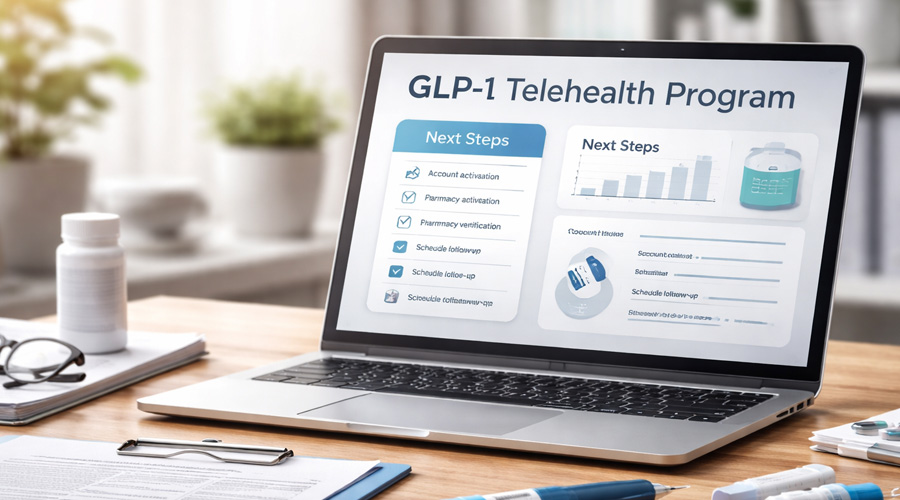
Program approval is only the beginning of a longer, structured process. What happens next depends on role boundaries, required steps, and how programs separate clinical decisions from platform operations. Understanding these distinctions explains why timelines look similar on the surface but differ in practice.
After approval, an online GLP-1 program timeline typically moves through defined stages rather than fixed dates. These stages commonly include onboarding steps, fulfillment coordination, and transition into an ongoing program phase. The sequence is consistent across many providers, but the pace and handling of each stage can differ.
Approval does not mean every next step is automatic or immediate. Licensed clinicians retain control over medical decisions, while platforms manage administrative and logistical processes. Each stage depends on required information being completed and reviewed.
Because programs separate clinical authority from platform operations, timelines vary by provider design. Differences often reflect how programs structure onboarding, verification, and continuation processes, not guarantees about speed, outcomes, or duration.
1. What Does “Approval” Actually Mean in an Online GLP-1 Program?
In online GLP-1 programs, approval typically refers to a licensed clinician determining that participation may proceed based on submitted intake information. This decision is clinical in nature and limited to eligibility at that point in time (NIH, 2023). It does not represent a guarantee of treatment, medication access, or ongoing participation.
Approval also does not finalize every downstream step. Programs typically treat approval as a gateway status that allows administrative and operational processes to begin. Common post-approval processes include:
identity verification
consent confirmation
coordination with pharmacy fulfillment partners
Because approval is a discrete clinical determination, it sits at the boundary between medical authority and platform operations. What follows depends on how each program structures its internal workflow, not on a single universal definition of approval.
Important Clarification
Program approval reflects a clinical eligibility decision made by a licensed clinician. It does not represent platform approval, completion of administrative requirements, or a guarantee that later operational or clinical steps will occur.
2. Who Decides What Happens After Approval in These Programs?
After approval, responsibility is typically split between licensed clinicians and the platform (Cleveland Clinic, 2024). Licensed clinicians retain authority over medical determinations, including whether prescribing or continued participation remains appropriate. Platforms do not override these decisions.
Table 1. Post-Approval Roles and Control Boundaries
Account setup, documentation handling, process coordination
Medical judgment, prescribing authority, clinical determinations
Platforms usually control non-clinical steps that follow approval. These steps may include account setup, documentation handling, and coordination with pharmacy fulfillment partners. These actions are operational rather than medical.
Because authority is divided, no single entity controls the entire post-approval timeline. Clinical decisions proceed on clinician judgment, while operational steps follow platform-specific processes and policies.
Important Clarification
Platforms coordinate administrative and logistical steps after approval, but they do not make medical determinations. Licensed clinicians retain independent authority over eligibility, prescribing, and ongoing clinical review.
3. What Information Is Still Required After a Program Approval?
After approval, programs often require additional non-clinical information before later stages can proceed (Mayo Clinic, 2024). This information is usually administrative and confirms details already provided during medical intake. It supports identity verification, record accuracy, and regulatory compliance.
Table 2. Administrative Information Commonly Required After Approval
Information category
Purpose
Clinical or administrative
Identity and contact details
Confirms records and account accuracy
Administrative
Consent forms and disclosures
Documents required acknowledgments
Administrative
Pharmacy fulfillment verification
Supports coordination with dispensing partners
Administrative
These requirements do not change clinical eligibility. They exist to complete operational checks that programs must satisfy before moving forward with post-approval processes.
Important Clarification
Requests for additional information after approval are administrative in nature. They do not represent a new clinical review, a reversal of eligibility, or a determination about future medical decisions.
4. What Does Approval Not Guarantee or Determine?
Program approval establishes eligibility at a specific point in time, but it does not lock in future conditions or outcomes (NIH, 2023). Many assumptions attach meaning to approval that programs explicitly do not define or promise.
Table 3. What Program Approval Does and Does Not Determine
Common assumption after approval
What approval actually determines
Medication access is guaranteed
Eligibility may proceed, but access is not promised
Participation will continue unchanged
Ongoing participation remains subject to review
Timing of next steps is fixed
No specific timing is determined by approval
Program conditions cannot change
Program rules and reviews still apply
Approval also does not determine duration, long-term structure, or continuity of participation. Platforms do not guarantee how operational steps unfold, and clinicians may reassess eligibility as information changes.
This distinction exists to prevent approval from being interpreted as a binding outcome. It reflects how online GLP-1 programs separate initial eligibility from future clinical and operational determinations.
5. Why Do Post-Approval Timelines Vary Between Programs?
Post-approval timelines vary because online GLP-1 programs are not built on a single operational model (APA, DSM-5-TR). Each program makes structural choices that shape how post-approval activity unfolds.
Common sources of variation include:
how intake information is processed and verified
how administrative checks are sequenced or combined
how coordination with external partners is handled
Because these differences are structural, timeline variation is expected. It does not indicate differences in medical decisions, quality, or outcomes, but rather how programs organize post-approval processes.
6. How Are Post-Approval Stages Commonly Structured by Programs?
After approval, many online GLP-1 programs organize activity into recognizable stages rather than a single continuous process. These stages help platforms separate administrative handling from clinical oversight while keeping responsibilities clearly defined.
Table 4. Common Post-Approval Stage Structure in Online GLP-1 Programs
Post-approval stage
What typically occurs
Who manages it
Onboarding and account activation
Account setup and required confirmations
Program platform
Verification and disclosures
Completion of required checks and acknowledgments
Program platform
Pharmacy fulfillment coordination
Administrative coordination with dispensing partners
Program platform
Ongoing program phase
Continued participation under program policies
Shared platform and clinician roles
Not every program labels these stages the same way. The structure reflects internal workflow design rather than a standardized industry timeline.
Important Clarification
Post-approval stages describe how programs organize responsibilities, not how long any stage lasts or whether each stage will occur in every case. Stage labels do not represent timelines, guarantees, or clinical outcomes.
7. What Are Common Misunderstandings About Post-Approval Timing?
Several common misunderstandings shape how post-approval timing is interpreted. These misunderstandings include:
approval sets a fixed or predictable timeline
all post-approval activity is clinician-driven
In practice, approval only confirms eligibility at a point in time. Many post-approval steps are administrative and depend on platform processes, external coordination, or required confirmations.
These misunderstandings often arise when approval is treated as a single event rather than a boundary between clinical review and operational handling.
8. Where Do Program Timelines End and Ongoing Participation Begin?
Post-approval timelines typically end once required onboarding and coordination steps are complete. At that point, programs shift from a defined setup phase into an ongoing participation structure managed through established policies and reviews.
This transition does not remove clinical oversight or operational limits. Licensed clinicians continue to determine medical appropriateness, while platforms manage access, records, and required processes.
Understanding this boundary helps clarify what the post-approval timeline explains and what it does not. It describes how programs are set up to proceed, not how long participation lasts or what outcomes occur.
Sources:
National Institutes of Health (NIH). Clinical decision-making and eligibility standards. 2023.
Cleveland Clinic. Telehealth roles and clinical authority overview. 2024.
Mayo Clinic. Telehealth administration and patient intake processes. 2024.
American Psychiatric Association. Diagnostic and Statistical Manual of Mental Disorders, Fifth Edition, Text Revision (DSM-5-TR).
National Institute of Mental Health (NIMH). Health information governance and clinical oversight principles. 2024.