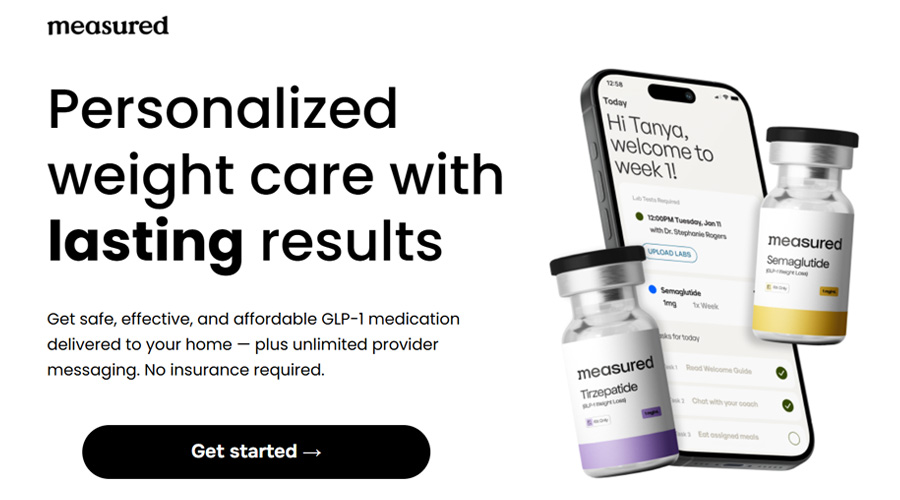
Measured structures its GLP-1 program through an intake-first funnel centered on “personalized” treatment. Public pages emphasize compounded GLP-1 access while withholding a full cost table, named pharmacy partners, and a state coverage list. Details on pricing, eligibility decisions, and mail‑order fulfillment appear later in intake and checkout.
This page contains affiliate links. GLP1files may receive compensation if enrollment occurs through the referenced links. This relationship does not influence editorial analysis, and all information is presented for independent informational purposes only.
This summary highlights the main structural points people often look for when comparing GLP-1 telehealth programs.
Pricing details appear late, with costs and billing mechanics clarified only after intake progression or checkout rather than on public pricing pages.
Clinical authority sits with licensed clinicians, who independently decide eligibility and prescribing after intake review, not at sign-up.
Compounded GLP-1 options dominate public messaging, while specific formulations and alternatives are not outlined upfront.
Pharmacy partners are not named publicly, leaving preparation, compounding, and shipping details unresolved until after approval.
State availability is intake-determined, with no centralized list showing where the program operates before enrollment.
User complaints most often center on timing and disclosure, especially around billing start points and pharmacy coordination rather than clinical care.
1. Measured Review Overview: What This Program Is and Who It’s For
Measured operates an intake-led GLP-1 telehealth program that collects medical information, routes cases to licensed clinicians, and coordinates mail-order pharmacy fulfillment when approved.
This review documents how enrollment unfolds, when costs become visible, how medication access is described, and which platform limits shape the overall process.
Eligibility and prescribing decisions are made by licensed clinicians, while Measured manages intake collection, account access, billing status, and coordination with pharmacies.
People researching Measured often focus on its late stage pricing disclosure, compounded-first messaging, and uncertainty that resolves only after intake and checkout progression.
2. Measured at a Glance: Cost, Medications, and Telehealth Model
Table 1. Measured Program Snapshot
Category
How Measured Is Structured
Program type
Intake-gated GLP-1 telehealth program where key details resolve progressively through online intake and clinician review.
States served
No centralized list of supported states is published, with availability clarified only during intake or checkout.
Medical review
Prescribing decisions are made by licensed clinicians after intake submission, without publicly disclosed criteria or review cadence.
Medications offered
Compounded GLP-1 options are emphasized publicly, with no guarantee of access to specific brands or formulations.
Pricing model
Self-pay pricing that becomes visible late in the intake or checkout flow rather than on a standalone pricing page.
Pharmacy sourcing
Pharmacy fulfillment is referenced generically, while partner pharmacies are not named on public pages.
Shipping method
Medication delivery occurs by mail after clinician authorization and downstream pharmacy processing.
Certifications
No certification badges or third-party accreditations are highlighted on public-facing pages.
Trustpilot rating
4.8 stars out of 5.0 stars from 160 user reviews as of January 15, 2026.
3. What Is Measured? Telehealth Weight Loss Program Explained
Measured functions as an intake-gated GLP-1 telehealth platform where most operational details resolve only after a user enters the evaluation flow. The program operates fully online, with no in-person visits, and separates platform access from medical authority. All prescribing decisions are made by licensed clinicians rather than by Measured itself.
Health information is submitted through a digital intake that acts as the primary gate to further details. Clinician review occurs after intake submission, and prescriptions are issued only if a clinician authorizes them, with fulfillment handled downstream by pharmacies.
Key structural elements of how Measured operates include:
Platform access centers on intake submission and account activation rather than upfront program disclosure.
Clinician authority determines eligibility and prescribing outcomes after intake, independent of enrollment status.
Medication access is framed using personalized language, with compounded GLP-1 options emphasized on public pages.
Pharmacy involvement appears after approval, while partner pharmacies are not identified before intake or checkout.
Program sequencing is disclosure-led, with pricing, eligibility outcomes, and fulfillment details resolving progressively.
Ongoing management structure and reassessment cadence are not operationally detailed on public-facing pages.
Table 2. When Key Decisions Occur in Measured’s Intake-Led Program
Program stage
What actually happens at this stage
Who controls the outcome
Before intake
Public pages reference personalized GLP-1 care while withholding pricing tables, pharmacy identities, and state availability details.
Measured controls content visibility, while no medical determinations are made.
During intake review
Submitted health information is reviewed to decide whether prescribing may proceed and what medication category applies.
Licensed clinicians control clinical decisions based on professional judgment.
After approval
Medication access is clarified and prescriptions are authorized before being routed for pharmacy fulfillment.
Licensed clinicians authorize prescribing, while pharmacies control preparation.
After fulfillment
Medications are shipped by mail and the account remains active under platform billing and access terms.
Dispensing pharmacies manage delivery, while Measured manages account and billing status.
What Measured Shows Before Intake vs What Resolves Later
This comparison highlights how Measured structures its program around staged information visibility rather than upfront disclosure.
Visible before intake
General references to personalized GLP-1 treatment without committing to specific medications or formulations.
Compounded GLP-1 access described at a high level, without pricing tables or pharmacy identification.
No centralized list of supported states or advance confirmation of geographic availability.
High-level mentions of clinician review without published approval criteria or timing detail.
Resolved after intake / checkout
Pricing structure and billing mechanics clarified across intake screens, checkout, and policy terms.
State availability confirmed on a case-by-case basis following intake review and administrative checks.
Pharmacy fulfillment identified as mail-order based, while partner pharmacies remain unnamed.
Medication category and access clarified only after licensed clinician review.
This section clarifies where Measured’s platform role ends, based on how the company publicly describes its intake-led structure, clinician review process, and pharmacy coordination model.
Medical decisions
Eligibility determinations are made by licensed clinicians following intake review, rather than by platform rules or automated screening.
Prescription approval or denial depends on clinician judgment, not completion of forms, payment status, or platform enrollment.
Medication selection, including whether compounded options are used, is decided by the prescribing clinician.
Dosing, continuation, or discontinuation decisions are controlled by clinicians and are not set or enforced by the platform.
Approval is not described as automatic or algorithmic, and no public criteria guarantee prescribing outcomes.
Clinical scope
The program does not function as a primary care practice or replace an ongoing patient-provider relationship.
Care outside GLP-1 weight loss, including unrelated medical conditions, is not described as part of the service.
In-person visits, physical examinations, urgent care, and emergency services are not offered through the platform.
Pharmacy control
Measured does not operate or publicly identify an in-house or owned pharmacy.
Pharmacy partners are referenced generically, without public disclosure of names, locations, or compounding roles.
Preparation timelines, inventory availability, compounding processes, and shipping speed are controlled by dispensing pharmacies.
Regulatory compliance for compounded medications is attributed to licensed pharmacies, not the platform.
Continuity, communication, and billing
Ongoing access is managed through an online account or portal rather than live or in-person communication.
Billing status, renewals, pauses, or cancellations follow platform terms rather than clinical milestones.
Charges are not described as contingent on approval, shipment timing, or medication outcomes.
Measured’s intake-gated disclosure model separates platform access from clinical and pharmacy decisions, which explains why approval, timing, fulfillment, and billing details can resolve at different stages of the process.
5. How Measured Works: Sign-Up, Medical Review, and Delivery
Measured’s program is structured around staged information disclosure rather than a single linear workflow. Key details become knowable at different checkpoints, depending on intake progression, clinician review, and pharmacy coordination. As a result, what is visible at one stage may remain unresolved at another.
Table 3. How Information Resolves Across the Measured Program
Process question
What becomes visible or resolved
Who controls it
What remains unresolved at this stage
When pricing becomes visible
Pricing and billing mechanics appear during intake progression or checkout rather than on public pages.
Measured controls when cost information is displayed.
Final medication costs and fulfillment charges.
When state availability is confirmed
State eligibility is clarified only after intake review and administrative checks.
Licensed clinicians and licensing constraints determine availability.
Public confirmation of coverage before intake.
When pharmacy sourcing details become known
Fulfillment is identified as mail-order pharmacy based after approval, without naming partners upfront.
Dispensing pharmacies control preparation and sourcing details.
Pharmacy identity prior to approval or checkout.
When prescribing is authorized
Medication access is confirmed following clinician review of intake information.
6. Is Measured Legit? How Legitimacy Is Established
Legitimacy in the Measured program is grounded in how access, review, and fulfillment are sequenced through an intake-gated structure rather than upfront verification or plan disclosure.
Trustpilot rating: 4.8 stars based on 160 user reviews as of January 15, 2026.
How legitimacy is established at Measured:
Licensed clinicians retain independent authority over eligibility and prescribing decisions, which are not automated or guaranteed by platform enrollment.
Intake-gated disclosure limits what can be verified before enrollment, with pricing, eligibility outcomes, and medication access clarified only after review.
Compounded GLP-1 options are emphasized publicly, while distinctions around formulation and sourcing resolve later in the process.
Pharmacy fulfillment is coordinated through licensed partners that are not named publicly, separating platform access from dispensing control.
External certifications or accreditation badges are not highlighted, placing emphasis on process structure rather than third-party validation.
Legitimacy within this system depends on clinician-led review and downstream pharmacy compliance, while several operational details remain unverifiable until intake progresses.
FAQ Spotlight: How Measured frames legitimacy
Intake-gated disclosure is used to frame legitimacy by deferring verification of pricing, eligibility, and fulfillment until clinician review and pharmacy coordination occur later in the process.
Medication access within Measured’s program is intentionally framed with limited specificity before intake, with most details resolving only after clinician review. Public pages emphasize personalization without committing to particular drugs, formulations, or sourcing pathways in advance.
What is visible before intake
Before intake begins, medication information remains high level and descriptive rather than itemized.
Public messaging emphasizes personalized GLP-1 treatment without naming specific drugs or formulations.
Compounded GLP-1 access is referenced broadly, without disclosing additives, concentrations, or preparation details.
Brand-name medications are not foregrounded, and no guarantees are made about which options may be available.
What resolves only after clinician review
Medication details become clearer only once intake information is reviewed and authorization decisions are made.
Licensed clinicians determine whether prescribing may proceed and which medication category is appropriate.
State licensing constraints shape what medications may be prescribed based on clinician authorization.
Pharmacy availability at the time of approval influences which compounded options can be prepared and dispensed.
Brand-name versus compounded determinations are made by clinicians rather than selected through the platform.
Table 4. Measured GLP-1 Medication Options
Medication type
Example products
Brand or compounded
Regulatory status
Determined by
GLP-1 medications
Not listed on public pages prior to intake
Compounded options emphasized without formulation detail
Compounded medications regulated at the pharmacy level
Licensed clinicians
FAQ Spotlight: Is a specific medication or brand guaranteed on Measured?
Medication choice is decided after clinician review, and no specific drug, brand, or formulation is guaranteed through enrollment or intake submission.
8. Measured Cost: Quick Answers
Is this monthly or one-time? Public pages do not show a consolidated price format, with recurring or one-time structure clarified later in intake or checkout.
When does billing start? Billing is tied to platform account activation or checkout completion rather than clinician approval or medication shipment.
What does the payment cover? Payment is described as covering platform access and coordination of intake and clinician review, with fulfillment handled separately.
Is medication included? Medication cost inclusion is not clearly stated on public pages and is typically clarified only after intake review and checkout.
FAQ Spotlight: Are there hidden fees?
Measured does not publish a complete pricing table upfront, so final cost details may appear across intake screens, checkout, and policy terms rather than in one place.
Measured operates as an online-only program where access is delivered through a digital platform, with administrative coordination separated from medical review. The platform facilitates intake, account management, and pharmacy coordination, while clinicians handle prescribing decisions. Ongoing access reflects platform terms rather than continuous clinical monitoring.
The delivery model functions entirely online, without in-person visits or physical clinic locations.
Communication occurs primarily through an account portal rather than live, ongoing clinician interaction.
Clinician involvement is limited to intake review and prescribing decisions, not continuous care management.
Fulfillment timing depends on pharmacy preparation and shipping processes outside direct platform control.
Program continuation or pauses follow platform account terms rather than medical reassessment schedules.
What Support Typically Covers
Assistance with account access, intake completion, and navigation of platform features.
Coordination between submitted intake information, clinician review, and pharmacy fulfillment steps.
Administrative handling of billing status, renewals, and platform-related questions.
What Measured Support Does Not Cover
Medical advice, treatment planning, or real-time clinical guidance beyond clinician review.
In-person care, urgent services, or management of non-GLP-1 medical conditions.
Control over pharmacy preparation timelines, inventory availability, or shipping speed.
10. Measured User Reviews and Complaints: What Users Commonly Report
Public feedback about Measured most often reflects how and when information becomes visible during enrollment, rather than the quality of clinical care. Reviews focus on expectation alignment around pricing, eligibility, communication, and pharmacy coordination as details resolve later in the process.
Common Positive Themes in Reviews
Intake completion and account setup are often described as straightforward once required information is submitted.
Fully online management is frequently noted, with users understanding access mechanics more clearly after intake review begins.
Clinician communication through the portal is commonly mentioned after medical review clarifies next steps.
The structure of clinician evaluation becomes easier to understand once eligibility decisions are communicated.
Greater clarity is often reported after pricing, medication access, and fulfillment details are disclosed later in the flow.
Common Complaints and Friction Points
Billing timing confusion often reflects pricing details becoming visible only after intake progression or checkout.
Cancellation questions commonly arise when subscription mechanics are clarified later rather than before enrollment.
State availability uncertainty appears when eligibility is confirmed case by case instead of through a public list.
Medication expectations sometimes differ from outcomes due to personalized language used before clinician review.
Pharmacy delays are often linked to unnamed partners and post-approval preparation rather than platform processing.
Why Measured Reviews Often Vary
Review variation largely tracks when key details become knowable, with experiences differing based on how early or late information resolves during intake, review, and fulfillment.
Table 5. Sources of Review Variation
Source of variation
Why experiences differ
Medication format
Compounded medication preparation and authorization details are clarified only after clinician review and pharmacy coordination.
Prior GLP-1 experience
Familiarity with disclosure-gated programs shapes expectations about when pricing and eligibility become visible.
Support needs
Users seeking early certainty report more friction than those expecting details to resolve later in the process.
FAQ Spotlight: What types of complaints are most commonly reported?
Reported complaints most often relate to late-stage pricing visibility, intake-dependent eligibility confirmation, and pharmacy coordination details that appear after enrollment steps begin.
Safety in the Measured program is shaped by an intake-gated design where clinical review happens after enrollment and pharmacy partners are not identified on public pages.
How safety oversight works at Measured
Medical decisions sit with licensed clinicians who review intake submissions and control prescribing without platform-set approval rules.
Medication handling is owned by dispensing pharmacies that prepare, label, and ship orders, while pharmacy partners remain unnamed in advance.
Care boundaries reflect a coordination model, with no publicly described in-person evaluation or ongoing clinical monitoring cadence.
Under this structure, safety oversight depends on clinician judgment and pharmacy compliance, while the platform remains an administrative access layer.
FAQ Spotlight: How is safety handled in the Measured program?
Intake-gated clinician authorization and unnamed pharmacy fulfillment place safety control downstream of enrollment rather than within a pre-verified program framework.
12. How Eligibility Decisions Work at Measured
Eligibility within the Measured program is determined only after intake submission and clinician review, with no public disclosure of decision mechanics before enrollment.
Before intake: Public pages describe personalized GLP-1 care at a high level, but no eligibility determinations or clinical judgments occur at this stage, and Measured controls only information display.
During review: Submitted intake information is evaluated by licensed clinicians, who decide whether prescribing may proceed, while the platform does not approve, deny, or influence outcomes.
After approval: Eligibility may be revisited through clinician judgment over time, but continuation is not automatic and remains outside direct platform control.
Eligibility decisions are never automatic and depend on clinician review rather than platform enrollment or payment status.
Submitting intake information allows clinicians to review eligibility, but approval is not guaranteed at any stage of the process.
FAQ Spotlight: Does completing the intake mean I will qualify at Measured?
Completing intake enables clinician review, but licensed clinicians make eligibility decisions independently, and approval is not guaranteed through platform participation alone.
13. Who Decides What at Measured? Control, Variability, and What Can Change
Decision-making inside the Measured program is divided across the platform, licensed clinicians, and pharmacies, with authority shifting by stage. Several outcomes remain conditional until intake review and fulfillment steps are completed.
Controlled by the Measured platform
Account creation, portal access, and intake routing are managed administratively through the online platform.
Billing status, renewals, pauses, and cancellations follow platform terms rather than clinical milestones.
Communication tools and intake visibility are controlled by the platform’s account system.
Coordination between clinicians and pharmacies is handled administratively without influencing medical decisions.
Controlled by licensed clinicians
Eligibility determinations occur after intake review and are not decided by enrollment or payment.
Medication selection, including compounded versus brand considerations, is determined by clinician judgment.
Decisions about continuation, changes, or nonapproval remain clinical and independent of platform control.
What can vary by case
Whether a prescription is approved following clinician review.
Total cost after review when medication and fulfillment details are clarified.
Fulfillment timing once pharmacy preparation and shipping processes begin.
What Is Typically Clear Before Sign-Up
Before enrollment, it is usually clear how responsibility is divided even if outcomes are not.
Prescription approval is determined by a licensed clinician, not by the platform.
The program uses out-of-pocket pricing, and costs may change after review.
A detailed online health intake is required before clinician evaluation occurs.
Billing and cancellation follow the terms published on the website.
FAQ Spotlight: Is Measured worth it?
This review does not assess value, outcomes, or suitability, but documents how approval authority, costs, and variability are structured within the Measured program.
This section consolidates the operational and structural facts documented throughout the review, without drawing conclusions or offering recommendations.
Measured manages account access, billing mechanics, intake routing, and coordination, while it does not make medical or prescribing decisions.
Licensed clinicians hold authority over eligibility assessment, medication selection, and prescribing outcomes after intake review.
Prescriptions are issued only following clinician approval, rather than through enrollment completion or payment alone.
Licensed pharmacies control medication preparation and shipping, which occur outside direct platform oversight.
The program operates on an out-of-pocket pricing model, with final costs varying after intake, review, and fulfillment details resolve.
Variability arises from clinician judgment, pharmacy availability, and program terms rather than fixed timelines or guarantees.
Under this structure, differences in approval, timing, cost, and fulfillment reflect how responsibilities are divided across the system rather than individual behavior.
FAQ Spotlight: What is this review meant to help with?
This review explains how Measured’s system works, what information is disclosed upfront, and where limits or variability apply, without advising participation or assessing results.
This review draws on publicly available materials that describe how Measured structures disclosure, intake, pricing visibility, clinician review, and pharmacy coordination at the time of writing.
Public-facing pages on Measured’s website that outline intake flow, late stage pricing visibility, compounded GLP-1 framing, and account-based access terms.
Policy pages and intake screens where details about billing triggers, cancellations, and coordination limits appear only after enrollment steps begin.
Public state licensing resources referenced to understand general clinician and pharmacy licensure requirements relevant to Measured’s operating model.
FDA materials describing regulatory distinctions between FDA‑approved GLP-1 medications and compounded formulations referenced in Measured’s disclosures.
Independent consumer review platforms and forums discussing enrollment timing, billing clarity, intake progression, and pharmacy fulfillment experiences specific to Measured.
Program details and disclosures may change as Measured updates its platform and enrollment flow. All medical decisions described in this review are made by licensed clinicians, not by the publisher.