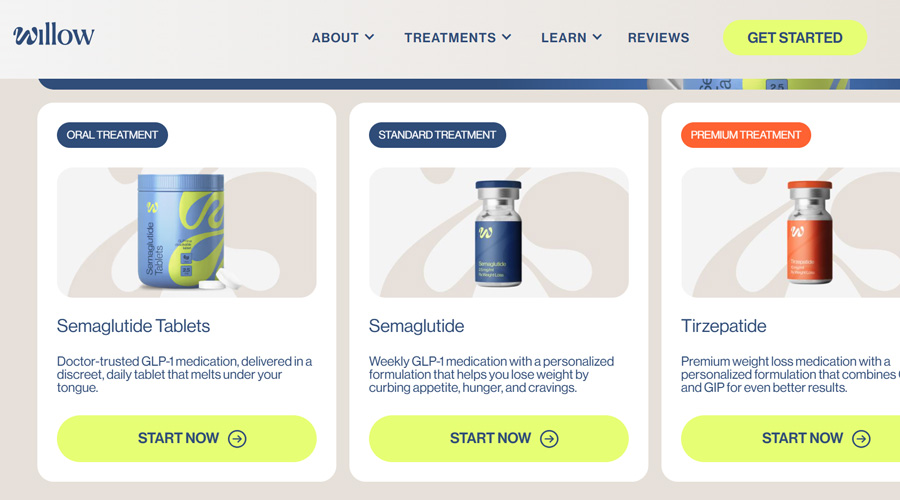
Willow describes itself as a U.S.-based GLP-1 telehealth platform that limits public disclosure of program specifics until after an online intake is completed. Public pages reference a required health questionnaire reviewed by a licensed clinician, with prescribing decisions made only after that review. Willow states that the program uses an out-of-pocket (no insurance) pricing model and that, if a prescription is approved, medication is dispensed through pharmacy partners that are not identified on the website.
This summary highlights the main structural points people often look for when comparing GLP-1 telehealth programs.
Key program details are intake-gated, with pricing, medication options, and next steps shown only after account creation and questionnaire submission.
Billing can begin before prescription approval, which is a frequent source of confusion noted in public feedback.
Licensed clinicians control eligibility and prescribing, while Willow limits its role to intake routing, billing, and coordination.
Pharmacy partners are not named publicly, creating uncertainty about fulfillment details until after approval.
Public disclosures are intentionally limited, including the absence of clinician lists, pharmacy names, or upfront medication menus.
User complaints often focus on timing and visibility, especially when charges appear before full program details are understood.
1. Willow Review Overview: What This Program Is and Who It’s For
This review documents how Willow presents its GLP-1 program, focusing on what is disclosed publicly versus what is revealed only after intake.
It describes Willow’s intake-gated enrollment flow, the point at which clinician review occurs, and how pricing information is surfaced during that process.
Prescribing and eligibility decisions are made by external licensed clinicians, with Willow’s role limited to intake collection, billing, and coordination.
Willow is often researched because its website withholds full pricing, pharmacy details, and clinician information until after enrollment begins, and because the program is structured as out-of-pocket rather than insurance-based.
2. Willow at a Glance: Cost, Medications, and Telehealth Model
Not published as a standalone list; availability is evaluated during intake and clinician review
Medical review
Prescribing decisions are made by external licensed clinicians after reviewing submitted intake information
Medications offered
GLP-1 medications are referenced without a public breakdown between brand-name and compounded options
Pricing model
Out-of-pocket pricing with full cost disclosure occurring after intake rather than on public pricing pages
Pharmacy sourcing
Pharmacy partners are referenced in general terms but are not named or listed publicly
Shipping method
Medication is shipped to the address on file only after clinician approval and pharmacy processing
Certifications
No third-party telehealth or pharmacy certifications are highlighted on the website
Trustpilot rating
3.6 stars (out of 5.0 stars) based on 299 user reviews as of January 9, 2026
3. What Is Willow? Telehealth Program Structure Explained
Willow describes its role as organizing enrollment and review steps through an online account rather than operating a clinic or employing prescribing clinicians. Public pages state that health information is collected through a required intake form and routed for clinician review, with prescribing decisions made outside the platform based on that submission.
Willow’s materials focus on coordination and access, while omitting advance detail about who the clinicians are or which pharmacies are used.
Key structural elements of how Willow operates, based on its disclosures, include:
Health information is submitted through an intake form before most program details are shown.
Prescribing decisions are made by licensed clinicians after intake review, not by the platform.
Willow does not publicly identify clinicians or list their credentials before review begins.
Pharmacy partners are referenced generally but not named on the website.
Pricing is described as out-of-pocket and is disclosed during enrollment rather than upfront.
Program access, billing, and coordination are handled through the Willow account system.
Ongoing participation depends on clinician decisions and program terms, not automatic continuation.
Table 2. When Key Decisions Occur in Willow’s Intake-Led Program
Program stage
Decision type
Who determines it
Before intake
What information is visible publicly and what is withheld until enrollment
Willow platform
During intake review
Whether an individual meets criteria for a prescription
Licensed clinician
After approval
Which GLP-1 medication, if any, is prescribed and how it is formulated
Licensed clinician
After fulfillment
Whether billing continues based on account status and cancellation actions
Willow platform
4. What Willow Does Not Manage or Control
This section documents the specific operational boundaries Willow establishes through its intake-gated design, where control shifts at defined points rather than remaining centralized.
Medical decisions
Willow does not make eligibility determinations, approve prescriptions, or decide whether treatment continues.
Medical authority enters the process only after intake submission, when a licensed clinician reviews the questionnaire outside the Willow platform.
Until that review occurs, Willow does not signal approval likelihood or apply medical screening rules.
Clinical scope
Willow does not present itself as a medical practice and does not offer care beyond GLP-1 prescribing routed through intake.
The program does not include scheduled visits, longitudinal care plans, or clinician relationships visible before enrollment.
No clinical services are initiated at account creation; all medical involvement is deferred until intake review.
Pharmacy control
Willow references pharmacy fulfillment only after clinician approval, without naming pharmacies or describing sourcing in advance.
Pharmacy selection, preparation method, and shipment timing occur downstream of both intake and clinician decisions.
These steps are not visible or configurable within the Willow account prior to approval.
Continuity and support
Willow limits communication to portal-based messages that appear only after enrollment progresses past intake.
Ongoing access is governed by account status and platform terms rather than by scheduled clinical follow-up.
Billing continuation and cancellation operate independently of clinician interaction once enrollment has begun.
These boundaries are specific to Willow’s enrollment sequence, where medical review, pharmacy fulfillment, and support visibility are introduced only after intake completion rather than disclosed at the outset.
5. How Willow Works: Sign-Up, Medical Review, and Delivery
Table 3. What Triggers Progress, Delays, and Stops in the Willow Program
Process question
What triggers it
Who controls it
What does not trigger it
What starts billing
Progression into Willow’s paid enrollment flow after intake submission
Willow platform
Account creation or viewing marketing pages
What moves the order forward
Clinician completes intake review and issues a prescription
Licensed clinician
Payment alone or intake submission without approval
What causes delays
Requests for additional intake information or pharmacy processing
Licensed clinician / pharmacy
Time elapsed or billing status
What stops the process
Clinician decides not to prescribe or account is canceled
Licensed clinician / Willow platform
Portal inactivity
The table above highlights several Willow-specific process details that are often misunderstood during enrollment:
Billing can begin once enrollment progresses past intake, even though medication approval has not yet occurred.
Payment alone does not advance medication fulfillment without a completed clinician review and prescription.
Requests for more intake information can pause progress, regardless of billing status.
Account inactivity does not automatically stop billing unless cancellation is completed under Willow’s stated terms.
6. Is Willow Legit? How Legitimacy Is Established
Willow’s legitimacy signals are tied to how the platform stages information release, not to what is posted on public pricing or provider pages.
The program is structured so that key operational identifiers remain undisclosed until after intake is submitted.
Trustpilot rating: 3.6 stars (out of 5.0 stars) based on 298 user reviews as of January 9, 2026
How legitimacy is framed in Willow’s public materials:
Willow treats the intake form as the entry point for verification, with most cost and medication detail withheld until after submission.
Willow places prescribing authority entirely with licensed clinicians who review intake information outside the Willow platform.
Willow separates billing from prescription approval in its flow, with charges described as recurring once enrollment moves past intake.
Willow references pharmacy fulfillment only at a high level and does not name pharmacy partners on public pages.
Willow does not publish a clinician roster, clinician credentials list, or a public medication menu before intake gating is cleared.
Willow does not highlight third-party telehealth certifications or pharmacy accreditations as a public trust signal.
Under this model, legitimacy is presented as a sequence.
The platform collects intake information, a clinician decides whether prescribing is appropriate, and pharmacy fulfillment follows only if approved.
FAQ Spotlight: Is Willow legit?
Willow describes itself as a platform that gates most program detail behind intake submission, routes health information to licensed clinicians for prescribing decisions, and coordinates pharmacy dispensing after approval. Enrollment and billing are managed through the Willow account system, while prescribing and dispensing remain external.
7. What Medications Does Willow Prescribe?
Willow describes medication access as occurring only after an intake-gated clinician review, with limited detail provided publicly about specific drugs before enrollment.
Medication access through Willow reflects several conditions that are disclosed only at a high level:
A completed online intake is required before any medication discussion occurs.
Prescribing decisions are made by licensed clinicians based on submitted intake information.
Willow does not publish a public list of medications, brands, or formulations available through the program.
The website does not state whether brand-name or compounded options are prioritized or routinely offered.
Medication availability depends on clinician judgment and pharmacy sourcing that is not disclosed in advance.
Table 4. Willow GLP-1 Medication Options
Medication type
Example products
Brand or compounded
Regulatory status
Determined by
GLP-1 (semaglutide)
Not listed publicly
Not disclosed
FDA-approved or compounded, if prescribed
Licensed clinician
GLP-1 (tirzepatide)
Not listed publicly
Not disclosed
FDA-approved or compounded, if prescribed
Licensed clinician
FAQ Spotlight: Is a specific medication or brand guaranteed on Willow?
Willow does not guarantee access to any specific medication, brand, or formulation. Medication decisions are made by licensed clinicians after intake review, and the platform does not disclose available options in advance.
8. Willow Cost: Quick Answers
Is this monthly or one-time?
Willow describes charges as recurring while an account remains active, rather than as a single purchase tied to medication shipment.
When does billing start?
Willow states that billing can begin once enrollment moves past intake submission, even if a clinician has not yet approved a prescription.
What does the payment cover?
The recurring charge is described as covering program access and clinician review, not a promise that medication will be prescribed.
Is medication included?
Willow indicates that medication costs are separate and are shown only after a licensed clinician approves a prescription.
FAQ Spotlight: Are there hidden fees?
Willow does not publish a comprehensive fee schedule on its public pages. Cost details are disclosed during enrollment, and medication-related charges depend on what a licensed clinician approves and what is presented during the intake process.
9. Access Features and Support Limits
Willow structures access around an account-based portal that activates features only as enrollment progresses, rather than offering standing access at sign-up.
Program access at Willow reflects several sequencing limits tied to its intake-gated model:
Entry into the program occurs through a Willow account, not through scheduled visits or live onboarding.
Support visibility changes only after intake submission and does not activate at account creation.
Licensed clinicians review intake information externally and do not interact through live visits or real-time messaging.
Medication-related updates appear in the portal only if a prescription is approved.
Continued access depends on account status under platform terms rather than on appointment cadence.
What Support Typically Covers
Account access, login issues, and navigation within the Willow portal.
Billing status, recurring charges, and cancellation requests processed through the account system.
Status updates tied to intake review or pharmacy coordination once approval has occurred.
Program messages that follow the enrollment sequence rather than open-ended clinical communication.
What Support Does Not Cover
Emergency or urgent medical situations of any kind.
Live clinical consultations, video visits, or on-demand messaging with clinicians.
Care unrelated to GLP-1 prescribing reviewed through Willow’s intake process.
Ongoing medical management outside the scope of portal-based coordination.
10. Willow User Reviews and Complaints: What Is Commonly Reported
Public feedback about Willow centers on how its intake-gated program is experienced rather than on clinical results. Reviews most often discuss when information becomes visible, how billing aligns with intake review, and how portal-based communication functions after enrollment.
Common Positive Themes in Reviews
Some reviews note that account creation is required before key details are shown, which sets expectations early for how the program operates.
Users frequently mention that all steps, including intake, review updates, and billing, are handled inside a single account portal.
Several comments describe clinician follow-up messages appearing only after intake submission, rather than before enrollment.
Reviews often reference clearer understanding of program limits once clinician review begins.
Some users state that the absence of in-person visits matches how Willow presents itself.
Common Complaints and Friction Points
Repeated questions appear about when charges begin relative to intake submission and clinician review.
Some reviews describe surprise at pricing details that are shown only after enrollment starts.
Users occasionally express confusion about medication availability due to the lack of a public medication list.
Delays are sometimes mentioned after approval, linked to pharmacy coordination that is not visible in advance.
Support-related complaints often focus on portal-only communication rather than on clinical decisions.
Why User Reviews Often Vary
Differences in feedback often reflect how individuals respond to Willow’s delayed disclosure model and dependence on external clinicians and unnamed pharmacy partners.
Table 5. Common Sources of Review Variation
Source of variation
Why experiences may differ
Disclosure timing
Pricing, medication details, and next steps are shown only after intake submission
Medication approval
Prescribing decisions vary by intake information, with no public approval criteria
Communication style
All updates occur through the portal without phone or live visit options
FAQ Spotlight: What types of complaints are most commonly reported?
Across public platforms, complaints most often relate to delayed pricing visibility, intake-linked billing, portal-only support, and pharmacy steps that are not explained in advance.
11. Is Willow Safe?
Willow frames safety primarily through what happens only after intake, and through what is not disclosed before enrollment.
The program does not publish a standalone safety protocol, monitoring schedule, or clinician directory on public pages.
How safety oversight works at Willow
When medical oversight begins: Willow routes safety oversight through an intake-gated clinician review that occurs only after the health questionnaire is submitted.
What the platform does not do: Willow does not describe itself as applying medical eligibility rules, approving prescriptions, or supervising clinical decisions inside the portal.
Where dispensing responsibility sits: Willow states that approved prescriptions are dispensed by licensed pharmacy partners, but those pharmacies are not identified publicly.
What is not described publicly: Willow does not publish pharmacy sourcing details, compounding controls, or shipping handling standards on the website.
How ongoing contact is framed: Willow describes program communication as portal-based and tied to enrollment status, rather than to routine clinical check-ins.
Under this structure, safety oversight is presented as a handoff.
A clinician reviews intake information to determine whether prescribing is appropriate, and pharmacy dispensing occurs only if a prescription is issued.
FAQ Spotlight: How is safety handled in the Willow program?
Willow describes safety oversight as occurring through intake-gated clinician review and licensed pharmacy dispensing after approval, while the platform’s public materials emphasize coordination rather than published monitoring standards.
12. How Eligibility Decisions Work at Willow
Willow ties eligibility decisions to a specific sequence: account creation leads to an intake form, and eligibility is evaluated only after that intake is submitted for external clinician review.
Willow does not publish a public eligibility checklist, qualifying thresholds, or advance approval indicators on its website.
How eligibility is evaluated in Willow’s intake-led flow
Before intake submission: Willow limits eligibility messaging to general statements and does not provide pass/fail criteria on public pages.
At intake submission: Eligibility evaluation begins only when the questionnaire is routed for review, which Willow describes as a clinician decision point outside the platform.
After clinician review: A prescription may be issued only if a licensed clinician determines prescribing is appropriate, and Willow does not present this as automatic.
If additional review is needed: Intake may be paused for follow-up questions, which delays progression even if enrollment has already started.
Over time: Continued participation remains conditional on clinician review and platform terms, rather than on a one-time approval at sign-up.
Under this structure, eligibility is treated as an intake-triggered decision, not as a feature that can be confirmed before the questionnaire is completed.
Submitting intake information enables clinician review, but acceptance into the Willow program is not guaranteed.
FAQ Spotlight: Does completing the intake mean someone qualifies at Willow?
Willow describes intake completion as the starting point for external clinician review. Eligibility decisions are made by licensed clinicians, and approval is not assured even when all requested information is submitted.
13. Who Decides What at Willow? Control, Variability, and What Can Change
Willow’s program divides control across the platform, external clinicians, and outside pharmacies, which explains why pricing details, medication access, and timing are not fixed or uniform.
Controlled by the Willow Platform
Creation and maintenance of the Willow account used to unlock intake, pricing disclosure, and program access.
Processing of recurring charges once enrollment progresses past intake.
Routing intake information to clinicians and coordinating approved prescriptions with pharmacies.
Display of messages, status updates, and billing information inside the online portal.
Controlled by Licensed Clinicians
Review of intake submissions and determination of whether prescribing is appropriate.
Selection of medication type and formulation based on intake information.
Decisions about continuation, changes, or discontinuation, which Willow does not override.
What Can Vary by Case
Total monthly cost once medication details are disclosed during enrollment.
Whether medication is approved at all, based on clinician judgment.
Fulfillment timing after approval, which depends on pharmacy processing Willow does not control.
What Is Usually Clear Before Sign-Up
Willow does not approve prescriptions or guarantee medication access.
Pricing and medication details are disclosed after intake rather than on public pages.
Participation requires completion of a detailed health questionnaire.
Billing and cancellation follow platform terms rather than clinician discretion.
FAQ Spotlight: Is Willow worth it?
This review does not assess whether Willow is worth it. It documents how Willow separates platform control from clinician authority and where variability enters the process.
14. What This Review Clarifies About Willow
The points below summarize the specific structural details this review documents about how Willow operates.
Willow uses an intake-gated model in which pricing, medication details, and next steps are disclosed only after account creation.
The platform manages enrollment, billing, and coordination but does not employ clinicians or make prescribing decisions.
Eligibility and medication decisions are made by external licensed clinicians after intake review.
Pharmacy partners dispense medication only after approval, and their identities are not disclosed publicly.
Costs are presented as out-of-pocket and may change based on clinician decisions and pharmacy fulfillment steps.
FAQ Spotlight: What is this review meant to help with?
This review documents how Willow structures disclosure, review, and billing through its intake-led program, and where information is limited or conditional, without evaluating outcomes or advising participation.
15. Sources and References
This review reflects how Willow publicly describes its program structure, disclosures, and limitations at the time of writing. Information availability may change as Willow updates its website or enrollment flow.
Source material reviewed for this article includes:
Willow’s official website content, including intake pages, pricing disclosures shown during enrollment, FAQs, and terms of service.
Public state licensing databases used to confirm clinician and pharmacy licensure frameworks when referenced by Willow, where accessible.
FDA publications related to GLP-1 medications and the regulatory status of compounded medications.
Public consumer review platforms where users describe enrollment, billing, and portal-based experiences with Willow.
All medical decisions described in this review are made by licensed clinicians, not by GLP1files. Willow’s disclosures, pricing presentation, and program structure may change after publication.