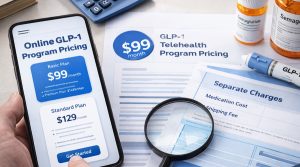
Self-pay in online GLP-1 programs can look simple at first, but the billing structure usually has multiple layers. This article explains where program fees end, where separate charges begin, and why payment, clinical review, and pharmacy fulfillment do not mean the same thing.
Self-pay in online GLP-1 programs usually means the program charges the patient directly instead of billing insurance for its main services. In most cases, self-pay covers access to the program, while medication, pharmacy fulfillment, lab work, or shipping may be billed separately.
Online GLP-1 self-pay pricing models usually fall into a few common formats. These include membership fees, bundled pricing, and pay-per-visit structures.
Payment starts the process, but it does not guarantee eligibility, prescribing, approval, or medication access. Licensed clinicians and dispensing pharmacies still control those decisions.
1. What Does Self-Pay Mean in an Online GLP-1 Program?
In online GLP-1 programs, self-pay usually means the patient pays the program directly instead of the program billing insurance for its main services.
That payment may cover intake, clinician visits, messaging access, or ongoing membership, depending on how the program is set up. It does not always include medication or other pharmacy-related costs.
In many programs, these charges are still listed separately:
Medication
Pharmacy fulfillment
Shipping
Lab work, when required
Follow-up or renewal charges
This is why the term can seem broader than it really is. Self-pay usually describes how the program collects payment, not a promise that every part of care, prescribing, and fulfillment is included in one price.
2. What Types of Self-Pay Pricing Models Do Online GLP-1 Programs Usually Use?
Online GLP-1 self-pay pricing models usually follow a few common formats. The labels may vary, but the underlying structure is often similar across programs.
One common model uses a recurring membership fee plus separate medication charges. In that setup, the program fee covers access to the platform or clinical process, while medication and pharmacy-related costs are billed on their own.
Another model uses bundled pricing. This combines major parts of the service into one listed charge, although some items may still be excluded.
Some programs also use pay-per-visit pricing instead of a recurring fee.
Table 1. Common Self-Pay Pricing Models
Pricing model
What the main charge usually covers
What may still be separate
Membership fee plus separate medication charges
Program access, intake, visits, or follow-up tools
Medication, pharmacy fulfillment, shipping, or lab work
Bundled pricing
Several major parts of the program combined into one listed charge
Some items, such as shipping or lab work
Pay-per-visit pricing
Individual consultations or review points
Medication and other pharmacy-related charges
Hybrid models with add-on charges
A recurring fee plus selected included services
Add-on services, medication, or other related costs
The main difference is usually what is included, what is billed separately, and how charges renew.
3. Who Handles Payment, and Who Decides Whether Treatment Is Approved?
In online GLP-1 programs, payment and treatment approval are usually handled by different parts of the system. The platform collects payment for program services, but licensed clinicians decide whether treatment is appropriate (CMS, 2025).
This distinction is central to how self-pay works. A completed checkout or active membership may open access to the program, but it does not mean clinical approval or guarantee a prescription.
Table 2. Who Handles Payment, Clinical Review, and Fulfillment
Part of the system
What it usually handles
What it does not control
Platform or program
Enrollment, account access, intake forms, scheduling, billing, and renewals
Clinical approval, prescribing, or pharmacy dispensing
Licensed clinician
Medical intake review, eligibility assessment, prescribing decisions, and requests for added information
Platform billing, account setup, or pharmacy inventory
Pharmacy
Pharmacy fulfillment, dispensing, and its own processing steps
Program enrollment, clinician review, or treatment approval
Pharmacies have a separate role as well. They handle pharmacy fulfillment and medication dispensing, and online pharmacies are expected to dispense prescription drugs only on receipt of a valid prescription ((NABP, 2018)). Self-pay starts the administrative process, but it does not control the medical or fulfillment outcome.
Important Clarification. Payment collection and clinical approval are not the same function. The platform may manage enrollment and billing, but licensed clinicians decide eligibility and prescribing.
4. What Usually Happens After Someone Checks Out or Enrolls in a Self-Pay Program?
In most online GLP-1 programs, self-pay follows a repeatable administrative flow. The exact steps vary, but the structure is often similar across platforms.
After checkout or enrollment, the program usually creates an account, collects intake details, and routes that information into the clinical review process. That may include health history, identity details, and scheduling or messaging access (HHS, 2024).
If the program uses a recurring model, renewals often continue on a set billing cycle. Scheduling, billing, check-in, and documentation are all part of telehealth workflow design, so medication-related charges may renew on a separate schedule from the program fee (HHS, 2026).
Table 3. Typical Self-Pay Enrollment and Renewal Flow
Step
What usually happens
What the step does not mean
Checkout or first payment
The program collects the first charge and starts enrollment or account access
Treatment is approved or a prescription is guaranteed
Account setup and intake forms
The platform gathers health details, identity information, and program preferences
Clinical review is complete
Clinical review
A licensed clinician reviews the submitted information and may request more details
A prescription will be issued
Ongoing billing or renewals
Recurring charges continue based on the program model
Ongoing eligibility is permanent
Follow-up requests, when included
The program may collect updates, schedule check-ins, or route new information for review
Medication shipment is automatic
This flow explains how payment moves through the system. It does not mean every step leads to treatment, prescribing, or medication shipment.
Important Clarification. Checkout, account setup, and intake submission are administrative steps. These steps move information through the program, but they do not confirm prescribing, dispensing, or shipment.
5. What Is Usually Included in Self-Pay, and What Is Often Charged Separately?
In online GLP-1 programs, self-pay transparency usually depends on how clearly the program separates platform services from medication-related costs. Some programs show one main fee first, then list other charges in less prominent detail. Others list each part separately from the start.
What is included often depends on the pricing model. A membership fee may cover access, intake, visits, or follow-up tools. A bundled fee may combine several of those parts into one charge.
Table 4. What Self-Pay Often Includes Versus What Is Often Separate
Cost layer
What it usually includes
What may still be separate
Program or membership fee
Access to the platform, intake, visits, or follow-up tools
Medication, shipping, or lab work
Bundled program fee
Several major parts of the program combined into one listed charge
Some pharmacy-related charges, shipping, or lab work
Medication-related charges
The medication itself and, in some cases, pharmacy handling
Program fees, renewals, or added services
Follow-up or renewal charges
Ongoing program access or later review points
Medication, shipping, or required lab work
This separation does not mean the program is unclear by default. It means self-pay usually involves more than one cost layer, and those layers are not always grouped together.
Important Clarification. A self-pay fee may describe only one part of the program. Medication, pharmacy fulfillment, shipping, lab work, or renewal charges may still appear as separate cost layers.
6. What Are the Main Cost Layers in Online GLP-1 Self-Pay?
Online GLP-1 self-pay usually works across more than one cost layer. That is one reason the total structure can look simpler on the surface than it is in practice.
Table 5. Main Cost Layers in Online GLP-1 Self-Pay
Cost layer
What it usually covers
How it may be billed
Program fee
Intake, visits, messaging, renewals, or general platform access
As a recurring fee, a bundled fee, or a visit-based charge
Medication and pharmacy charges
Medication and pharmacy fulfillment
Together with the program fee or as a separate charge
Added charges when required
Shipping, lab work, or other related costs
Only when needed, and sometimes on a different billing cycle
This layered structure helps explain why one listed fee does not always reflect the full self-pay setup. Each layer may be billed together, separately, or on a different renewal cycle.
Important Clarification. A listed self-pay fee may reflect only one layer of the total structure. Medication, shipping, lab work, or renewal-related charges may still appear on separate billing cycles or as separate charges.
7. What Are the 3 Separate Gates in Online GLP-1 Self-Pay?
Online GLP-1 self-pay usually moves through three separate gates. This is one of the clearest ways to understand why payment does not control the full process.
The first gate is payment. That step opens access to the program and starts the administrative process. The second gate is clinical review. A licensed clinician reviews intake information and decides whether treatment is appropriate. The third gate is pharmacy fulfillment. That step covers dispensing, inventory, and shipment processing.
Table 6. The 3 Separate Gates in Online GLP-1 Self-Pay
Gate
What it controls
What it does not control
Payment gate
Program access, enrollment, and billing
Clinical approval or pharmacy dispensing
Clinical gate
Eligibility review and prescribing decisions
Program billing or pharmacy inventory
Fulfillment gate
Dispensing, inventory checks, and shipment processing
Enrollment, payment collection, or clinical approval
This framework helps explain why self-pay can move forward in one part of the system while another part is still pending.
Important Clarification. Payment, clinical review, and pharmacy fulfillment are separate gates. Passing one gate does not mean the next gate is complete.
8. What Does Self-Pay Not Guarantee in an Online GLP-1 Program?
Self-pay does not guarantee eligibility, prescribing, medication availability, or ongoing access to treatment. It only describes how payment is collected for the program’s services.
Those later decisions remain separate from the payment step. Licensed clinicians decide whether treatment is appropriate. Pharmacies handle dispensing, inventory, and shipment processing.
Self-pay does not determine:
Clinical approval
Prescription issuance
Pharmacy inventory
Shipping timing
Continued renewal eligibility
This is the main boundary around the term. Self-pay explains the billing model, but it does not control the full medical or fulfillment outcome (CMS, 2025; NABP, 2018).
Important Clarification. Self-pay describes the billing model only. It does not determine clinical approval, prescription issuance, pharmacy inventory, or continued access to treatment.
Sources:
Centers for Medicare & Medicaid Services. MLN901705 – Telehealth & Remote Monitoring. December 2025.
U.S. Department of Health and Human Services. Asynchronous Direct-to-Consumer Telehealth. September 24, 2024.
U.S. Department of Health and Human Services. Planning Your Telehealth Workflow. January 20, 2026.
National Association of Boards of Pharmacy. Internet Drug Outlet Identification Program. September 5, 2018.
National Association of Boards of Pharmacy. Internet Drug Outlet Report. September 2018. https://nabp.pharmacy/wp-content/uploads/2018/09/Internet-Drug-Outlet-Report-September-2018.pdf