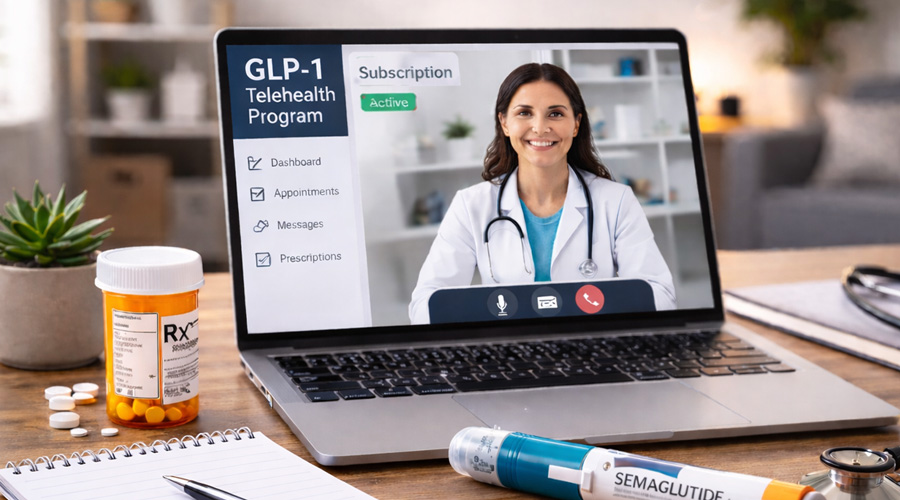
GLP-1 telehealth programs use subscription models to structure access, billing, and clinician oversight. The recurring fee defines enrollment and service access, but it does not determine prescription approval or eligibility. The structure separates platform services from licensed clinician authority.
Subscription models work in GLP-1 telehealth programs by charging a recurring fee for ongoing access to medical review, clinician oversight, and platform support. Instead of paying per visit, members enroll in a GLP-1 telehealth subscription that bundles care coordination and administrative services under one structure.
The subscription model defines how cost and access are structured, but licensed clinicians control eligibility and prescription decisions.
Medication may be included or billed separately, and approval is never guaranteed within a subscription-based GLP-1 telehealth program.
1. What Does a Subscription Mean in a GLP-1 Telehealth Program?
In this setting, a subscription means ongoing enrollment in a structured telehealth program rather than a one-time transaction. The model is designed around continuous access instead of isolated appointments.
Most GLP-1 telehealth subscription programs include:
Access to a licensed clinician for review and follow-up
A defined medical intake process and eligibility assessment
Secure messaging or platform-based communication
Administrative coordination and account management
The subscription defines access to services, but it does not transfer clinical authority from the licensed clinician to the platform (Cleveland Clinic, 2024).
2. How Is a GLP-1 Subscription Different from Paying Per Visit?
A GLP-1 subscription model is built around recurring access, while pay-per-visit care is built around single appointments. The structural difference affects how services are grouped and billed.
Table 1. Subscription Model vs Pay-Per-Visit Structure
Structural Element
Pay-Per-Visit Model
Subscription-Based GLP-1 Telehealth Program
Billing approach
Each consultation is billed as a separate transaction
A recurring fee maintains active enrollment
Access continuity
Access is limited to scheduled appointments
Access remains active during the enrollment period
Follow-up reviews
Follow-up may require separate billing
Follow-up reviews are part of the structured program
Administrative support
Support is tied to each individual visit
Platform support continues without separate visit charges
The distinction is structural rather than clinical, since licensed clinicians control medical decisions in both models.
3. What Is Usually Included in a GLP-1 Telehealth Subscription?
Most subscription-based GLP-1 telehealth programs bundle access to a defined set of services. The exact bundle varies by provider, but the structure is usually consistent.
Services that may be part of the subscription include:
Medical intake collection and documentation review
Clinician review and follow-up during active membership
Secure messaging or platform communication
Care coordination and administrative support
Some programs also include education or tracking tools. These tools support the program, but they do not replace clinical judgment (Mayo Clinic, 2024).
4. Who Makes Medical Decisions in a Subscription-Based GLP-1 Program?
In subscription-based GLP-1 telehealth programs, licensed clinicians make all medical decisions. The subscription fee does not purchase a prescription or guarantee medication approval.
Table 2. Clinical Authority and Platform Responsibility Split
Responsibility Area
Licensed Clinician
Telehealth Platform
Regulatory Basis
Medical intake review
Reviews health history and documentation
Collects and transmits intake data
State licensure and clinical standards
Eligibility decision
Determines clinical eligibility
Does not determine eligibility
Clinical judgment under state law
Prescribing authority
Issues or declines prescriptions
Cannot prescribe medication
Prescribing governed by medical license
Ongoing monitoring
Oversees treatment when appropriate
Provides communication tools
Ongoing care subject to safety review
The table reflects a control split. Clinicians retain prescribing authority, while the platform manages access, billing, and communication within the subscription structure.
Important Clarification. Payment of a subscription fee establishes program access and platform services. It does not transfer prescribing authority from licensed clinicians to the telehealth platform.
5. What Costs Are Tied Directly to a GLP-1 Subscription Fee?
The subscription fee pays for access to the telehealth program rather than for a specific medication. It reflects how the platform structures ongoing services and clinician access.
The table reflects structural cost differences. The subscription governs program access, while medication and fulfillment costs depend on the provider’s GLP-1 telehealth subscription model.
Important Clarification. A subscription fee covers access to defined services. It is not a bundled purchase of medication unless explicitly structured as such by the provider.
6. Does a GLP-1 Subscription Guarantee a Prescription?
A GLP-1 telehealth subscription does not guarantee that a prescription will be issued. The recurring fee provides access to evaluation and oversight, not automatic approval.
Incomplete or inaccurate data may delay or prevent approval
Clinical eligibility standards
Licensed clinician
Determines whether medication is appropriate
State telehealth rules
State medical boards and regulators
May limit prescribing across state lines
Ongoing safety review
Licensed clinician
May result in continuation, adjustment, or discontinuation
The table reflects decision dependencies. If a clinician determines that semaglutide, tirzepatide, or another option is not appropriate, the subscription structure does not override that decision.
Important Clarification. Enrollment in a GLP-1 telehealth subscription provides eligibility review. It does not ensure prescription approval, which remains subject to clinical judgment and state law.
7. What Structural Variations Exist Among GLP-1 Subscription Models?
Not all GLP-1 telehealth subscription models are structured the same way. Providers use several recurring billing designs that change how medication and services are grouped.
Table 5. Common GLP-1 Subscription Architecture Types
Model Type
How Medication Is Handled
How Services Are Billed
Bundled model
Medication is included in the recurring fee
One combined monthly charge covers services and medication
Membership plus pharmacy billing
Medication is billed separately through a pharmacy
Subscription fee covers clinician access and platform services
Hybrid model
Base subscription covers services, medication may be added
Core fee with variable add-on charges
These structural variations affect cost presentation and billing flow. They do not change clinician authority or prescription standards.
8. How Do Providers Present Subscription Pricing Publicly?
GLP-1 telehealth providers present subscription pricing in different formats. The structure of the display can affect how costs are understood.
Common public pricing formats include:
A single monthly price that includes services only
A bundled monthly price that includes medication and services
A base membership price with medication listed as a separate add-on
Tiered pricing that changes based on medication type
Pricing presentation does not change clinician authority. It only reflects how the provider organizes billing information.
9. How Does a Subscription Affect Ongoing Access to Care?
A GLP-1 telehealth subscription keeps program access active during the enrollment period. Access ends if the subscription is not maintained.
Ongoing access within the subscription model may include:
Periodic clinician review of treatment status
Continued platform messaging and communication
Adjustments based on updated medical information
Coordination with pharmacy fulfillment when applicable
The subscription governs access to services over time, but it does not change clinical standards or guarantee continued approval.
10. What Are the Structural Limits of Subscription Models in GLP-1 Telehealth Programs?
Subscription models define how services are organized and billed, but they do not determine clinical outcomes. The recurring fee governs access to the program, not the outcome of clinical review.
A GLP-1 telehealth subscription does not:
Guarantee eligibility approval
Require a clinician to prescribe medication
Replace state or federal prescribing rules
Ensure continued treatment over time
The subscription model explains how access and cost are structured, while licensed clinicians retain full control over medical decisions within regulatory limits (HHS, 2024).
Important Clarification. Subscription models define billing and access mechanics. They do not alter regulatory requirements, clinical standards, or the independent authority of licensed clinicians.
Sources:
U.S. Department of Health and Human Services. Telehealth policy and prescribing guidance. 2024. https://telehealth.hhs.gov/providers/telehealth-policy
Cleveland Clinic. Telemedicine overview and virtual visit expectations. 2024. https://health.clevelandclinic.org/telemedicine-what-to-expect-virtual-doctor-visit
Mayo Clinic. Telehealth technology and clinical care overview. 2024. https://www.mayoclinic.org/healthy-lifestyle/consumer-health/in-depth/telehealth/art-20044878
U.S. Department of Health and Human Services. Telehealth for providers overview. 2024. https://telehealth.hhs.gov/providers