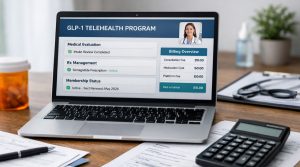
GLP-1 membership fees can appear simple on the surface, but the structure behind them separates platform services, clinician authority, and medication costs. Understanding what the fee actually controls clarifies what is included, what is billed separately, and what is never guaranteed.
GLP-1 program membership fees usually cover access to a telehealth platform and the services that support clinician review and ongoing care management. Most GLP-1 telehealth membership fees include medical intake processing, clinician oversight, secure messaging, and care coordination, but they do not include medication cost.
Membership fees are separate from charges billed for semaglutide or tirzepatide when prescribed.
Licensed clinicians determine eligibility and prescribing decisions, while platforms manage administrative and communication services without guaranteeing approval.
1. What Is Usually Included in a GLP-1 Program Membership Fee?
GLP-1 membership fees typically cover the non-medication services required to operate the program. These services create the structure that allows clinician review and care coordination within a telehealth model. They reflect the operational side of care delivery rather than the pharmacy component of treatment.
Common inclusions and exclusions can be separated as follows:
Table 1. Membership Fee Coverage vs Medication Exclusions
Category
What Is Included
What Is Not Included
Platform Access
Telehealth platform access and secure portal use
Medication cost for semaglutide or tirzepatide
Clinical Review
Medical intake review by a licensed clinician
Automatic medication approval
Ongoing Oversight
Clinician oversight during active participation
Pharmacy fulfillment charges
Communication
Secure messaging for care coordination
Shipping or dispensing fees
Administrative Support
Account management and coordination support
Drug pricing or supply costs
These services support evaluation and monitoring but do not include the cost of semaglutide, tirzepatide, or pharmacy fulfillment.
2. Who Makes Medical Decisions in a GLP-1 Membership Program?
Medical decisions within a GLP-1 membership program are made by a licensed clinician, not by the platform. This includes evaluating medical intake details, reviewing health history, and applying professional standards of care. The telehealth platform facilitates communication, but it does not exercise independent clinical authority (NIH, 2023).
Clinical roles and platform roles can be separated as follows:
Table 2. Clinician Authority vs Platform Management Roles
Entity
Primary Responsibility
Examples of Control
Licensed Clinician
Medical evaluation and judgment
Determine eligibility, decide whether semaglutide or tirzepatide is appropriate, adjust or discontinue treatment, request additional health information
Telehealth Platform
Program administration and communication systems
Provide secure account access, maintain messaging systems, coordinate administrative communication, offer technical support for portal use
Membership fees cover access to clinician review, but they do not purchase or guarantee a prescription.
Important Clarification. Platform enrollment and payment provide access to clinician review services, not a pre-approved prescription. Prescribing authority remains solely with the licensed clinician after medical evaluation.
3. What Administrative Services Are Covered by GLP-1 Membership Fees?
GLP-1 membership fees typically include the administrative functions that support communication and program coordination. These functions ensure that documentation, messaging, and internal routing operate within the telehealth system.
Administrative components commonly include:
Account setup and secure profile management.
Access to messaging systems for clinician communication.
Coordination between the platform, clinician, and pharmacy fulfillment.
Technical support for portal access or documentation uploads.
General customer service for non-clinical questions.
These services help maintain program operations, but they do not replace clinical judgment or determine prescribing outcomes.
4. Does The Membership Fee Include The Cost Of Medication?
In most GLP-1 telehealth programs, the membership fee does not include medication cost. The fee is structured to cover access to services rather than the purchase of prescription drugs.
Medication cost is typically billed separately when a licensed clinician issues a prescription for semaglutide or tirzepatide.
Membership services and medication charges can be separated as follows:
Table 3. Membership Services vs Medication Charges
Category
Covered by Membership Fee
Covered by Medication Cost
Clinical Intake
Medical intake processing
Pharmacy fulfillment and dispensing
Prescribing Oversight
Clinician oversight
Listed cash price of semaglutide or tirzepatide
Communication
Secure messaging access
Shipping when delivery is required
Care Coordination
Care coordination within the telehealth structure
Drug pricing determined by the pharmacy
The membership fee supports evaluation and oversight, while medication cost reflects the pharmacy component of care. Telehealth membership pricing models typically separate service access from pharmacy fulfillment to align with prescribing and dispensing regulations.
Important Clarification. A membership fee covers telehealth services and oversight, while medication charges reflect pharmacy pricing and fulfillment. These are separate functions within the care model.
5. What Information Do GLP-1 Programs Require As Part Of Membership Review?
GLP-1 membership programs require health information so a licensed clinician can complete a medical review. This requirement ensures that clinical decisions are based on documented health data rather than automated approval systems (Mayo Clinic, 2024).
Information commonly requested includes:
Completion of a medical intake questionnaire.
Disclosure of current medications and relevant health history.
Self-reported height and weight data.
Identification details needed for clinician verification.
Consent forms related to telehealth services.
Membership fees support the processing and review of this information, but submission does not guarantee eligibility or prescription approval.
6. What Does A GLP-1 Membership Fee Not Cover Or Guarantee?
A GLP-1 membership fee does not guarantee eligibility, a prescription, or medication approval. Payment provides access to evaluation services, not a pre-approved treatment decision.
Clinical determinations are made only after review of submitted medical information under applicable standards of care (Cleveland Clinic, 2024).
Membership boundaries can be separated as follows:
Table 4. What Membership Provides vs What It Does Not Guarantee
Category
Membership Provides
Membership Does Not Guarantee or Cover
Clinical Access
Access to clinician review
Automatic prescribing of semaglutide or tirzepatide
Medication Availability
Telehealth communication tools and oversight
Guaranteed access to FDA-approved or compounded medication
Treatment Results
Administrative coordination and intake processing
Clinical outcomes or treatment results
Pharmacy Pricing
Care management support within the platform
Pharmacy pricing or medication supply stability
Emergency Care
Platform-based care coordination
Emergency or in-person medical care
The fee provides access to evaluation and oversight services, but all clinical decisions remain subject to licensed clinician judgment and medical standards.
Important Clarification. Payment of a membership fee does not secure eligibility, medication approval, or treatment continuation. Clinical decisions are determined independently under applicable standards of care.
7. Why Do GLP-1 Membership Inclusions Differ Between Programs?
GLP-1 membership inclusions differ because telehealth platforms structure services in different ways. Publicly listed program pages show that membership pricing and bundled services can vary by provider and by state.
Each platform defines which operational tasks are bundled into the base fee and which are separated into distinct service categories.
Variation may reflect:
Compliance with state-specific telehealth licensing and prescribing rules.
The scope of clinician oversight included in the base fee.
Whether messaging access is limited or ongoing.
How care coordination with pharmacy fulfillment is handled.
The level of administrative support bundled into membership.
Some programs bundle more services into the membership fee, while others separate certain functions into distinct charges. These structural differences affect what the membership fee covers, but they do not change clinician authority over medical decisions (NIMH, 2024).
8. Are GLP-1 Membership Fees The Same As Paying For Medication?
GLP-1 membership fees are not the same as paying for medication. The membership fee covers access to evaluation, clinician oversight, and administrative services, while medication cost reflects pharmacy fulfillment and drug pricing.
Confusion often occurs when programs display a single monthly figure that combines services and medication. In structured models, these components represent different functions and may be itemized separately.
Important Clarification. A combined monthly figure does not mean that services and medication are the same product. Telehealth oversight and pharmacy fulfillment operate under different roles and responsibilities.
9. What Does A GLP-1 Membership Model Ultimately Control?
A GLP-1 membership model controls access to platform services and clinician review, not medical outcomes or prescribing certainty. It defines the operational framework through which clinical evaluation is delivered within a telehealth setting.
The membership fee supports intake processing, communication tools, and care coordination within the telehealth structure. It does not determine eligibility, guarantee medication approval, or replace independent clinical judgment.
Licensed clinicians retain authority over prescribing decisions and treatment management. The platform manages administrative systems, but it does not override medical standards, telehealth licensing requirements, or prescribing regulations.
Sources:
U.S. Food and Drug Administration. Prescribing and dispensing requirements. https://www.fda.gov/drugs
National Institutes of Health. Telehealth and digital health information. 2023. https://www.nih.gov/health-information/telehealth
Mayo Clinic. Telehealth overview and clinical review standards. 2024. https://www.mayoclinic.org/healthy-lifestyle/consumer-health/in-depth/telehealth/art-20044878
Cleveland Clinic. Standards of care and clinical evaluation process. 2024. https://my.clevelandclinic.org/health/articles/telemedicine
National Institute of Mental Health. Health information standards and medical review principles. 2024. https://www.nimh.nih.gov