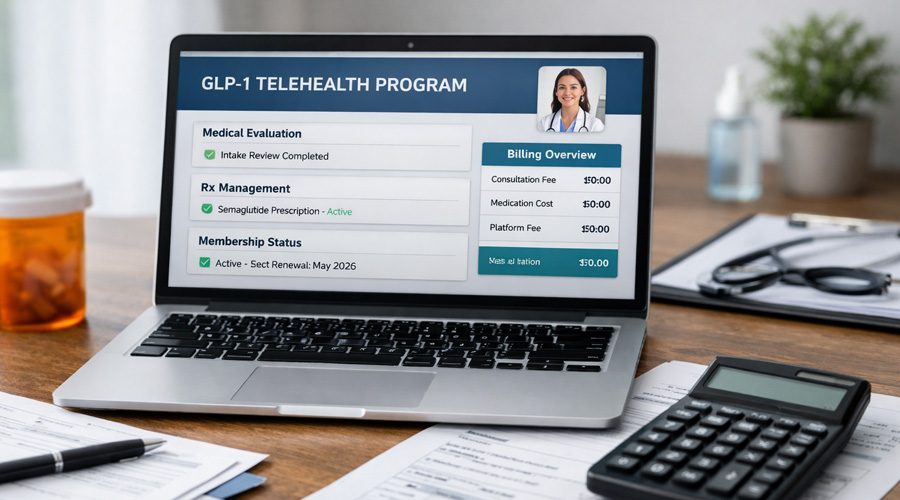
GLP-1 program costs can look similar at first glance, yet the structures behind them differ in meaningful ways. The variation reflects how online telehealth programs divide clinical authority, pharmacy sourcing, and platform operations.
GLP-1 program costs vary between providers because online GLP-1 telehealth programs are built and priced differently. Care models, clinician involvement, included services, pharmacy sourcing, and platform operations all shape how costs are structured and presented. The medication itself is only one part of the total price.
Some programs bundle medical review, prescription services, and support into a single recurring fee.
Others separate clinician oversight, platform fees, and medication charges. Licensed clinicians control prescribing decisions, while platforms manage enrollment systems, coordination, and pharmacy fulfillment. These structural differences explain why online GLP-1 program costs vary between providers.
1. What Parts Make Up the Total Cost of an Online GLP-1 Program?
Online GLP-1 program costs usually combine several separate components. The total price reflects both medical services and platform operations, not medication alone.
Most programs structure costs around the following components:
Table 1. Core Components of GLP-1 Program Costs
Cost component
What it covers
Medical intake review
Initial evaluation of health history by a licensed clinician
Ongoing clinician oversight
Follow-up assessments and required monitoring
Platform membership fees
Access to the telehealth system and account management
Prescription coordination
Processing and communication between clinician and pharmacy
Pharmacy fulfillment
Medication preparation, packaging, and shipping
Customer support
Administrative assistance and account-related help
Some programs bundle these elements into one recurring charge. Others list them separately. The way these parts are grouped or separated directly affects how GLP-1 program costs appear across providers.
Important Clarification
The total program price reflects how services are packaged, not whether a prescription will be issued. Clinical eligibility is determined separately by a licensed clinician after medical review.
2. Who Decides the Medical Costs Versus the Platform Fees?
GLP-1 program costs reflect two separate areas of control. Licensed clinicians oversee medical decisions, while telehealth platforms manage technology, coordination, and administrative services.
Control boundaries in most online GLP-1 programs can be outlined as follows:
Table 2. Clinical Versus Platform Responsibilities in GLP-1 Programs
Licensed clinician responsibilities
Platform responsibilities
Review medical intake information
Set membership and service fees
Determine prescribing eligibility
Manage billing systems
Decide whether semaglutide or tirzepatide is appropriate
Maintain account infrastructure
Establish monitoring requirements
Coordinate communication workflows
Issue prescriptions when clinically appropriate
Oversee platform operations and support systems
Pharmacies operate separately and handle medication preparation and pharmacy fulfillment.
Medical decisions do not automatically determine total program cost. Platform pricing models, staffing levels, and service scope also influence how GLP-1 program costs are structured and displayed.
Important Clarification
Platform fees do not authorize prescribing decisions. Licensed clinicians independently determine eligibility and medication selection based on medical intake and review.
3. What Services Are Usually Included in a GLP-1 Program’s Price?
GLP-1 program costs vary based on which services are included in the advertised price. Some programs offer broader support structures, while others limit services to core medical review and prescription coordination.
Commonly included services may include:
Initial medical intake and eligibility review
Secure messaging with a licensed clinician
Prescription issuance when clinically appropriate
Care coordination between clinician and pharmacy
Ongoing progress check-ins at defined intervals
Access to educational resources within the platform
Programs that include more clinician access or administrative support often reflect those additions in their cost structure. Programs that limit interaction or services may present lower base fees but separate additional services elsewhere in the pricing model.
4. Why Does Clinical Oversight Affect GLP-1 Program Costs?
Clinical oversight is a required part of any online GLP-1 telehealth program. Licensed clinicians must review medical history, assess eligibility, and determine whether prescribing is appropriate (NIH, 2023).
Programs with more structured oversight often include:
Detailed medical intake forms and health record review
Scheduled follow-up evaluations
Ongoing monitoring requirements set by the clinician
Documentation and compliance tracking
Secure communication systems that meet health privacy standards (HHS, 2024)
Higher levels of clinician involvement require staffing, administrative coordination, and compliance infrastructure. These operational requirements can increase overall GLP-1 program costs compared to models that limit ongoing clinical interaction.
Important Clarification
Higher program costs often reflect expanded clinical oversight or compliance systems. They do not represent a guarantee of approval, medication access, or treatment outcomes.
5. Why Do Online GLP-1 Care Models Differ From One Program to Another?
Online GLP-1 programs are not built under a single standard care model. Telehealth platforms must comply with state licensure rules and prescribing regulations, which can affect staffing models and administrative design (HHS, 2024). Each platform designs its structure based on staffing, technology systems, and the level of clinical involvement it supports.
Care model differences often include:
Frequency of required clinician check-ins
Whether communication is scheduled or message-based
Degree of care coordination handled by the platform
Use of affiliated versus independent pharmacies
Internal compliance and documentation systems
Programs with higher staffing levels and more defined clinical workflows reflect those systems in their cost structure. Programs built around lighter administrative models may present a different pricing format. These structural design choices directly influence how GLP-1 program costs are structured across providers.
6. How Do Pharmacy Relationships Change How GLP-1 Programs Price Medication?
Pharmacy relationships are a structural factor in how GLP-1 program costs are presented. Online GLP-1 programs may work with affiliated pharmacies, independent partner pharmacies, or broader pharmacy networks.
Pharmacy structure differences can be outlined as follows:
Table 3. Pharmacy Models and Their Impact on GLP-1 Program Pricing
Pharmacy model
How medication is billed
Fulfillment structure
Impact on cost presentation
Affiliated pharmacy
Often bundled with program fee
Coordinated within platform system
Appears as a single combined price
Independent partner pharmacy
Frequently billed separately
Coordinated between platform and external pharmacy
May show distinct service and medication charges
Broader pharmacy network
May depend on network agreement
Prescription sent to selected pharmacy
Medication pricing may be less centralized
Compounded medication sourcing
Typically billed through dispensing pharmacy
Prepared by compounding pharmacy when applicable
Cost reflects sourcing and preparation model
Medication pricing is influenced by pharmacy sourcing agreements, supply arrangements, and fulfillment models (FDA, 2024). These operational differences contribute to why online GLP-1 program costs vary between providers, even when the same medication is prescribed.
7. Which Parts of a GLP-1 Program Are Optional or Structured as Add-Ons?
Not all components of an online GLP-1 program are always included in the base price. Some services are structured as optional features or tiered upgrades within the platform.
Ancillary lab coordination when requested by a clinician
When programs separate core medical review from optional services, the base fee may appear lower. Total GLP-1 program costs can increase when add-on services are selected or required within a specific care model.
8. Why Is It Misleading to Assume All GLP-1 Programs Cost the Same?
It is common to focus only on the advertised monthly price. That figure may not reflect differences in clinical access, pharmacy sourcing, or service scope.
Cost comparisons can become misleading when:
One program bundles medication and services while another separates them
One program includes ongoing clinician oversight while another limits follow-up
One platform provides structured care coordination while another offers minimal administrative support
Medication sourcing differs between FDA-approved products and compounded medication (FDA, 2024)
Optional services are required in certain care models but not others
GLP-1 program costs represent a combination of medical review, operational design, and pharmacy fulfillment. Assuming uniform pricing ignores the structural differences that make each online GLP-1 telehealth program distinct.
9. What Do GLP-1 Program Costs Cover, and What Do They Not Determine?
GLP-1 program costs reflect how an online telehealth platform structures medical review, clinician access, pharmacy coordination, and administrative services. They describe the design of the program, not the outcome of treatment.
Cost boundaries can be clarified as follows:
Table 4. What GLP-1 Program Costs Cover Versus What They Do Not Determine
What GLP-1 program costs cover
What GLP-1 program costs do not determine
Medical intake review and clinician evaluation
Prescription approval by a licensed clinician
Access to clinician communication systems
Specific medication selection such as semaglutide or tirzepatide
Prescription processing and coordination
Long-term access to medication
Pharmacy fulfillment logistics
Clinical outcomes or health changes
Platform administration and support services
Future pricing stability across all program elements
Licensed clinicians determine eligibility and prescribing decisions based on individual medical review (Cleveland Clinic, 2024). Platforms determine how services are packaged and billed. Understanding this division clarifies why GLP-1 program costs vary between providers and what those costs represent within the system.
Important Clarification
Program costs describe service structure and operational design. They do not determine clinical decisions, future prescribing status, or individual health results, which remain under clinician authority.
Sources:
National Institutes of Health. Prescription Drugs and Clinical Oversight Overview. 2023. https://medlineplus.gov/prescriptiondrugs.html
U.S. Department of Health and Human Services. Health Information Privacy and Security Guidance. 2024. https://www.hhs.gov/hipaa/for-professionals/security/index.html
U.S. Food and Drug Administration. FDA-Approved Drugs and Compounding Information. 2024. https://www.fda.gov/drugs
Cleveland Clinic. How Prescription Medications Are Evaluated and Prescribed. 2024. https://my.clevelandclinic.org/health/drugs
U.S. Department of Health and Human Services. Telehealth Policy and Licensing Overview. 2024. https://telehealth.hhs.gov/